The blockchain gaming industry is experiencing unprecedented growth, with the global market projected to reach $70 billion in the coming years. As more entrepreneurs and businesses explore this lucrative opportunity, understanding the true blockchain game development cost becomes crucial for making informed investment decisions. While surface-level estimates are readily available, hidden costs and factors are often overlooked until deep into the development process.
Understanding Blockchain Game Development Economics
Before diving into specific costs, it’s essential to understand what makes blockchain game development fundamentally different from traditional game development. The blockchain game development cost structure differs significantly from conventional gaming projects due to the unique technological requirements and infrastructure needs.
Blockchain games enable true ownership via NFTs and decentralized economies.
Unlike traditional games, players don’t just buy or rent assets.
This shift adds complexity, infrastructure needs, and operational costs.
These factors significantly raise development expenses.
The integration of blockchain technology means developers must account for smart contracts, cryptocurrency wallets, NFT marketplaces, and decentralized networks, all of which require specialized expertise and ongoing maintenance. When partnering with a professional game app development company, understanding these unique requirements helps set realistic budget expectations from the start.
The Real Numbers: Blockchain Game Development Cost Breakdown
Let’s break down the cost thoroughly in this section.
Basic to Mid-Level Games: $40,000 – $80,000
For entrepreneurs entering the blockchain gaming space, simple to moderately complex games typically fall within this range. A basic blockchain game development cost starts around $40,000 and can extend to $80,000 depending on features and functionality. These games generally include:
Simple gameplay mechanics
Basic NFT integration
Single blockchain platform support (typically Polygon or Binance Smart Chain)
Standard smart contracts for transactions
Essential wallet integration (MetaMask or similar)
Basic tokenomics structure
Advanced Blockchain Games: $80,000 – $300,000+
More sophisticated blockchain games with complex features can range from $80,000 to over $300,000. The blockchain game development estimate for these projects includes:
Advanced 3D graphics and immersive environments
Multi-chain compatibility
Complex NFT ecosystems with breeding or crafting mechanics
Play-to-Earn (P2E) reward systems
In-game NFT marketplaces
DAO governance integration
Metaverse compatibility
Real-time multiplayer functionality
For highly complex AAA blockchain games with extensive features, cutting-edge graphics, and sophisticated game economies, costs can easily exceed $600,000. Working with experienced blockchain game development service providers can help optimize these costs while maintaining quality.
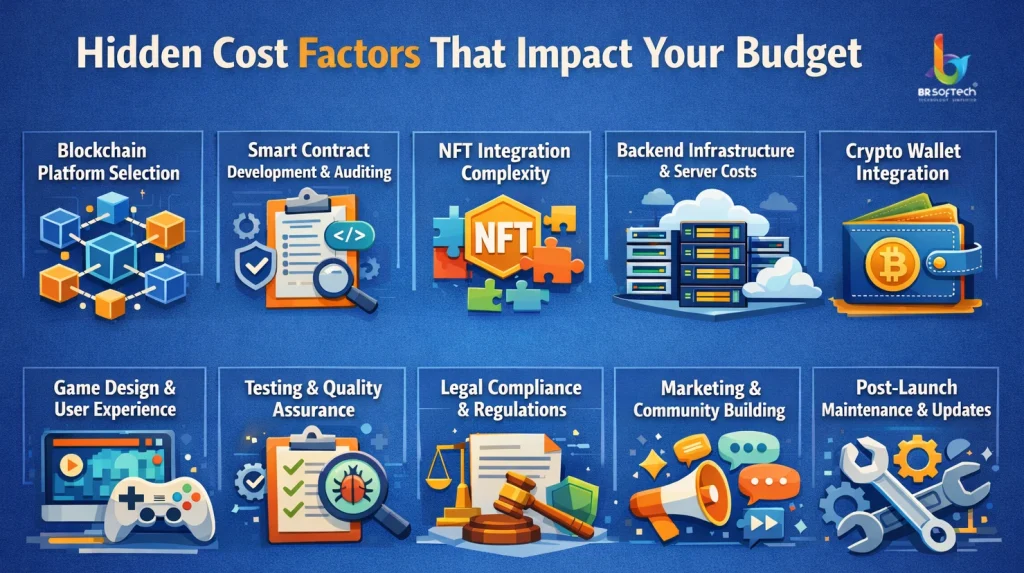
There could be some hidden costs that may come as a surprise when you are developing a blockchain game. Here are the details of the same:
1. Blockchain Platform Selection
The choice of blockchain platform significantly influences the blockchain game development cost. Each platform has distinct characteristics affecting both development and operational expenses:
Ethereum: Ethereum offers strong security and the largest developer community, but its high gas fees can make frequent transactions costly. Development costs are 20-30% higher than alternatives, though it offers better decentralization and trust.
Binance Smart Chain (BSC): Offers lower transaction fees and faster processing, ideal for frequent microtransactions. Development costs are typically 15-25% lower than Ethereum.
Solana: Solana, known for fast transactions and low fees, suits games needing quick processing. Game development costs also include specialized developer expertise, adding 10-15% to the base costs.
Polygon: Polygon, as a Layer 2 Ethereum scaling solution, offers security and lower fees, reducing operational costs by 40-60% compared to Ethereum mainnet.
2. Smart Contract Development and Auditing
Smart contracts are the backbone of blockchain games, automating in-game transactions, ownership transfers, and reward distributions. However, smart contract development represents a high hidden cost:
Initial Development: $5,000 – $25,000, depending on complexity
Security Audits: $10,000 – $50,000 (often overlooked but essential)
Updates and Maintenance: $2,000 – $10,000 annually
Gas Optimization: Additional $3,000 – $15,000 to reduce player transaction costs
Security audits are particularly crucial as vulnerabilities in smart contracts can lead to exploits costing millions. Professional NFT game development requires comprehensive testing and multiple audit rounds to ensure player assets remain secure.
3. NFT Integration Complexity
NFT integration goes beyond simple token creation. The blockchain game development estimate must account for:
NFT Minting Infrastructure: $8,000 – $20,000
Metadata Storage Solutions: $5,000 – $15,000 (IPFS or decentralized storage)
Rarity Algorithms: $3,000 – $12,000
Dynamic NFT Mechanics: $10,000 – $30,000 (for NFTs that evolve or change)
Marketplace Integration: $15,000 – $40,000
Advanced NFT features like breeding, crafting, or staking mechanisms can add $20,000 – $50,000 to the overall budget. These hidden costs often surprise developers who underestimate the complexity of creating truly innovative NFT experiences.
4. Backend Infrastructure and Server Costs
While blockchain handles asset ownership, most games still require traditional backend infrastructure for gameplay, user management, and data storage:
Cloud Hosting: $500 – $5,000 monthly, depending on player base
Database Management: $300 – $2,000 monthly
CDN Services: $200 – $1,500 monthly for global content delivery
API Development: $10,000 – $30,000 initial setup
Load Balancing: $1,000 – $5,000 monthly for high-traffic games
These ongoing operational costs are often excluded from initial blockchain game development cost estimates but can significantly impact profitability over time.
5. Crypto Wallet Integration
Seamless wallet integration is crucial for user experience but comes with development and maintenance costs:
Multi-Wallet Support: $5,000 – $15,000
Custom Wallet Development: $20,000 – $60,000
Mobile Wallet Integration: $8,000 – $20,000
Security Implementation: $5,000 – $15,000
Transaction Monitoring: $2,000 – $8,000
Supporting multiple wallets (MetaMask, Trust Wallet, Coinbase Wallet, etc.) improves accessibility but increases both development time and costs.
6. Game Design and User Experience
Exceptional design is what sets successful blockchain games apart, but quality comes at a price:
Concept Art and Storyboarding: $5,000 – $25,000
Character Design: $3,000 – $15,000 per unique character
Environment Design: $10,000 – $50,000
UI/UX Design: $8,000 – $30,000
Animation: $5,000 – $40,000 depending on complexity
Sound Design and Music: $5,000 – $20,000
Premium visual quality and smooth user experience are essential for player retention, making design investment critical to long-term success.
7. Testing and Quality Assurance
Blockchain games require more extensive testing than traditional games due to financial implications:
Functional Testing: $8,000 – $20,000
Smart Contract Testing: $10,000 – $25,000
Security Penetration Testing: $15,000 – $40,000
Performance Testing: $5,000 – $15,000
User Acceptance Testing: $3,000 – $10,000
Cross-Platform Testing: $5,000 – $15,000
Insufficient testing can lead to exploits, loss of player funds, and irreparable reputation damage, costs that far exceed initial QA investment.
8. Legal Compliance and Regulations
Regulatory compliance varies by jurisdiction and can significantly impact blockchain game cost factors:
Legal Consultation: $10,000 – $50,000
KYC/AML Implementation: $15,000 – $40,000
Terms of Service and Privacy Policies: $3,000 – $10,000
Securities Law Compliance: $20,000 – $100,000 (for games with tokenomics)
Regional Licensing: $5,000 – $50,000 per jurisdiction
Countries have varying regulations regarding cryptocurrency and NFTs. Non-compliance can result in fines, legal action, or being banned from major markets.
9. Marketing and Community Building
Success in blockchain gaming heavily depends on community engagement and strategic marketing:
Pre-Launch Marketing: $20,000 – $100,000
Influencer Partnerships: $10,000 – $50,000
Social Media Management: $3,000 – $10,000 monthly
Discord/Telegram Community Management: $2,000 – $8,000 monthly
Content Creation: $5,000 – $20,000 monthly
PR and Media Outreach: $10,000 – $40,000
Community building starts months before launch and requires sustained investment. A strong community can drive organic growth and reduce customer acquisition costs over time.
10. Post-Launch Maintenance and Updates
The blockchain game development cost doesn’t end at launch. Ongoing maintenance includes:
Bug Fixes and Updates: $5,000 – $20,000 quarterly
New Feature Development: $10,000 – $50,000 per major update
Server Maintenance: $500 – $5,000 monthly
Smart Contract Updates: $3,000 – $15,000 annually
Security Monitoring: $2,000 – $10,000 monthly
Customer Support: $3,000 – $15,000 monthly
Industry data suggests allocating 15-20% of initial development costs annually for maintenance and updates.
Game Complexity and Type Impact on Costs
The game’s complexity and type also impact the cost of blockchain game development. Let’s understand it through a table.
Game Complexity Level
Estimated Cost Range
Key Features
Simple Blockchain Games
$25,000 – $55,000
Basic 2D graphics, simple game mechanics, limited NFT integration, single-player or basic multiplayer, one blockchain platform
Moderate Complexity Games
$60,000 – $300,000
2D/3D graphics, multiple game modes, advanced NFT ecosystems, play-to-earn mechanics, multi-platform support, community features
Complex AAA Blockchain Games
$300,000 – $600,000+
High-end 3D graphics, open-world environments, complex economic systems, cross-game asset interoperability, metaverse integration, advanced AI and procedural generation
Strategies to Optimize Blockchain Game Development Costs
There are many strategies through which you can optimize your development costs, such as creating an MVP, choosing the right platform, etc. Let’s understand it in depth.
Start with a Minimum Viable Product (MVP)
Launch with core features to validate market demand before investing in advanced functionality. An MVP approach can reduce initial blockchain game development cost by 40-60% while providing valuable user feedback for future development.
Choose the Right Blockchain Platform
Selecting a cost-effective blockchain platform like Polygon or Binance Smart Chain can significantly reduce both development and operational costs. Platform choice should balance transaction costs, security requirements, and target audience preferences.
Leverage Existing Tools and Frameworks
Utilizing pre-built blockchain game engines, NFT frameworks, and smart contract templates can reduce development time by 30-50%. Open-source tools and standardized protocols accelerate development while reducing costs.
Outsource to Experienced Teams
Working with specialized blockchain game development teams in cost-effective regions can reduce expenses by 30-40% compared to in-house development. However, prioritize experience and proven track records over the lowest cost.
Implement Modular Development
Build games with modular architecture, allowing incremental feature additions. This approach spreads costs over time and enables revenue generation earlier in the development cycle.
Plan Token Economics Carefully
Well-designed tokenomics reduces the need for constant rebalancing and costly economic adjustments post-launch. Invest in economic modeling upfront to avoid expensive corrections later.
The True Value Proposition
While the blockchain game development cost may seem substantial, the potential returns justify the investment. Successful blockchain games generate revenue through:
Play-to-Earn Mechanisms: Taking small percentages of player earnings
In-Game Purchases: Traditional microtransactions enhanced with true ownership
Token Appreciation: Value increase of native game tokens
Staking and DeFi Integration: Revenue from player asset staking
Licensing and Partnerships: Cross-game collaborations and IP licensing
Leading blockchain games have demonstrated the model’s viability, with some generating millions in monthly revenue. The key is understanding all costs upfront and building sustainable economic models.
Why Choosing the Right Development Partner Matters?
Selecting an experienced blockchain game development partner is crucial for controlling costs and ensuring success. Look for:
Proven Track Record: Portfolio of successful blockchain games
Technical Expertise: Deep knowledge of blockchain platforms, smart contracts, and game development
Transparent Pricing: Clear blockchain game development estimate with detailed cost breakdowns
Post-Launch Support: Comprehensive maintenance and update services
Security Focus: Emphasis on smart contract audits and player asset protection
Community Building: Experience in blockchain gaming community management
Conclusion
The true cost of blockchain game development exceeds initial estimates due to hidden expenses like smart contract auditing, NFT infrastructure, maintenance, legal compliance, and marketing, which can double or triple costs. However, with proper planning, budgeting, and experienced partners, blockchain gaming provides significant opportunities for innovation and profit.
Understanding these secrets helps you make informed decisions, avoid costly mistakes, and build valuable blockchain games with strong returns. Whether creating a simple card game or an ambitious metaverse, thorough cost planning ensures a solid financial start.
The blockchain game development estimate should account for all phases and include contingencies for unexpected challenges. By partnering with proven blockchain game development services providers and planning for both obvious and hidden costs, you position your project for long-term success in this rapidly evolving industry.
Ready to Build a Profitable Blockchain Game?
Whether it’s a simple NFT game or a full-scale metaverse project, partner with experienced blockchain game developers to turn your idea into a scalable success.
How long does it take to develop a Blockchain game?
Blockchain is an emerging technology not yet fully exposed. Developing a flaw-free full-cycle game could take 6 months to a year, depending on complexity. Integrating blockchain into an AAA game might take up to five years.
How much does a game development design cost?
Cost varies by game type and platform. Hyper-casual games have simple designs and lower costs, from $5K to $1M, unlike AAA games.
How much is the Blockchain Gaming industry worth?
The value of the Blockchain gaming industry exceeded $4.6 billion in 2022 and is poised to reach around $65.7 billion by the end of 2027.
What is the average cost of developing a blockchain game?
The typical cost to develop a blockchain game is approximately $50,000, covering basic game design, wallet integration, and other related services blockchain.
What are the factors that influence blockchain game development cost?
Blockchain game development pricing is mainly influenced by the game design, the developers’ location, the selected blockchain platform, wallet integration, and legal compliance.
Nitin Garg is a seasoned tech entrepreneur and the visionary founder of BR Softech, a globally recognized leader in game development. With over 13 years of industry experience, he has been instrumental in transforming BR Softech into a powerhouse of innovation, offering cutting-edge solutions in Video Games, Blockchain Games, NFT Game Development, and card games like Poker, Rummy, and Teen Patti.
Nitin’s deep expertise in emerging technologies, combined with a sharp business acumen, has helped position BR Softech as a trusted name in the international gaming arena. Under his leadership, BR Softech has built a global clientele of 3,000+ satisfied customers and scaled a dedicated in-house team of 180+ skilled professionals.