Let me be direct with you: I’ve been in the game development consulting space long enough to know what separates operators who build profitable card game platforms from those who waste six figures chasing the wrong development model. There is frequently only one area where differences in pricing between two games exist: comprehension of what you are purchasing before you make a single purchase.
Teen Patti has developed from obscurity as merely another social gaming title to a significant revenue generator for gaming companies located throughout the world today. I can attest to this based on my personal experience of watching this game change and evolve over the last several years; 2018 was when it officially transitioned from social to traditional real-money form; but as I stated above, it continues to be one of the least expensive ways for someone who wishes to enter the online gaming market to do so.
I am confident that your business is asking you, as a gaming operator or business owner, “how much does it cost to create a Teen Patti game app?” This blog answers that question clearly and efficiently. You will receive a detailed answer that does not contain any ambiguous language.
Why Teen Patti Is Still a Smart Business Bet in 2026?
Dollars will come into discussion; however, first we need to discuss the market, as one of the major mistakes I see made by new operators of gaming businesses is that they greatly underestimate just how large and how global the gaming opportunity is now looking in terms of growth.
The global market for mobile trading card games is expected to be $4.10 billion by 2032, with a compound annual growth rate of 7.2%, and the total market for card games, including digital card games, is expected to be $2.95 billion this year. About 1/3 of the total market will come from the US, with US revenue coming in at approximately $898 million this year.
Here’s what that means for you as a business owner: you’re not chasing a trend. You’re entering a structurally sound, expanding market with documented revenue proof points. Teen Patti Gold alone has surpassed 20 million downloads with a daily active user base of over 1 million players, and those numbers predate the post-pandemic mobile gaming surge.
Why does an online Teen Patti business specifically perform well for operators? Let’s understand this through pointers:
Low infrastructure overhead compared to graphics-heavy games
High session frequency: players return multiple times per day
Multiple monetization layers
Cultural familiarity with South Asian diaspora communities in the USA, UK, and Canada
Scalable architecture: you can start lean and grow.
Teen Patti Variations: Why Game Depth Drives Retention
One of the most powerful retention mechanics I consistently recommend to operators is offering multiple Teen Patti variations within a single platform. Players who exhaust the standard format often churn, but when you offer a rich menu of variants, session time and return visits increase dramatically.
Based on what’s performing well on active platforms right now, the most popular variations to build include:
Muflis
AK-47
Joker Hunt
999
Auction
Lowball
Must-Have Features of a Competitive Teen Patti Game App in 2026
When I evaluate a Teen Patti app for competitiveness, I look at three layers: core gameplay mechanics, platform infrastructure, and monetization architecture. Here’s what every serious operator needs to build.
Real-Time Multiplayer
Multiplayer is a non-negotiable in card games in 2026. One cannot expect the AI to play on behalf of their friends, since the technology has crossed many boundaries. You must keep this feature in your Teen Patti game. Do not forget to add sockets (e.g., WebSockets/Socket.io), as it allows real-time play when going through the Teen Patti game and allow for lower latency.
Bot Table Fill System
If the table is of 6 players and 2 players are not matching due to less traffic, AI bots should instantly fill the gaps. Bots created from AI will play on tables as much as possible during off-peak hours to have more table activity, as well as provide liquid tables for players.
Blind & Seen Play Mechanics
Some developers have the difficulty of intertwining blind and seen mechanics, meaning that if one player is playing blind and the other is playing seen, the mechanics become hard to develop. All authentic Teen Patti rules will be incorporated into the game, with a full hand ranking and server logic to accurately evaluate all players’ hands.
Sideshow & Show Options
Same as blind and seen, sideshow and show options should also feature in your game, as they are a must-have. Players will have the option to request a sideshow or to perform a card comparison via the card-comparison algorithm to promote fair play.
Multiple Table Types
If you want to play on a private table or multiple tables at once, the game should provide you with this feature. There will be several different types of games available, including Quick Rounds, Classic, High-Stakes, and Private Tables, to reach different types of players.
Guest Play Mode
To provide a very smooth onboarding for players who do not want to create an ID on the platform, you must provide a guest play mode. Players will start playing without requiring registration and therefore will have a smooth onboarding.
The Real Cost to Create a Teen Patti Game App: A Full Breakdown
Here’s the conversation most card game developers avoid having with you, because giving you a real number requires them to admit the range is wide. Let me do it properly.
The cost to create a Teen Patti game app is influenced by five primary variables: feature scope, platform (iOS/Android/Web), UI/UX complexity, development team location, and security/compliance requirements. Below is an honest tier-based breakdown.
Gaming license fees: Varies wildly by jurisdiction – $2,000 to $500,000+
Marketing and user acquisition: Typically 30-50% of development budget in Year 1
Customer support infrastructure: $1,000-$5,000/month
Annual security audits: $2,000-$8,000
What Factors Affect the Cost of Building a Teen Patti Card Game?
Building a Teen Patti card game involves several cost factors across development, design, and operations. Here’s a breakdown of the key ones:
Platform Choice
The platform you build your app on will greatly affect your overall cost; cross-platform apps (using tools such as Flutter or React Native) are cheaper than making two separate native apps, but native apps typically offer better performance when playing real-time card games.
UI/UX Design Quality
Teen Patti is a graphics-intensive game that has lots of card animations, customizable avatars, a variety of themes for tables, and high-quality graphics. As a result, creating this game requires skilled graphic designers and significant time to create each graphic, which in turn results in a large increase in the expected budget for developing the App.
Backend Infrastructure
For real-time multiplayer gaming, a solid backend with low-latency game servers (usually using WebSockets) and matching logic and session management are needed. Furthermore, large-scale concurrent players would require significant expenditure on infrastructure to support them in the future.
Development Team Location & Size
If you hire developers from India, you can expect to pay much less than if you were hiring them from the US or Western Europe. A complete development team typically consists of a project manager, backend developer, front end/developer(game), UI/UX designer, and QA tester.
Licensing and Legal Compliance
Lastly, if you are operating in a regulated market, there will probably be a large (ten-thousand+) fee to get a gambling license and ongoing legal compliance with state laws especially in India where each state has their own rules.
The Teen Patti App Development Process: Step by Step
Understanding the development process helps you track project progress and hold your development partner accountable.
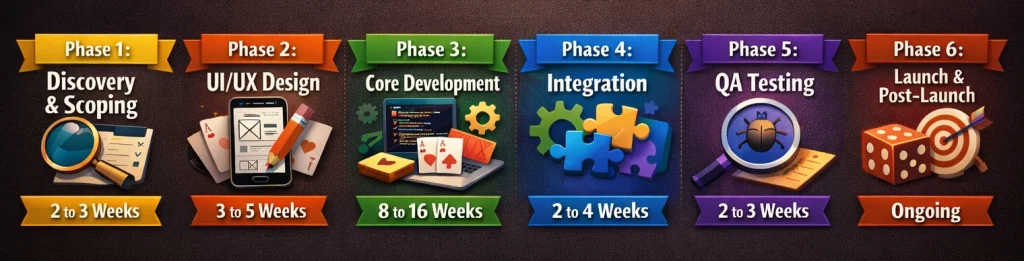
Phase 1: Discovery & Scoping (2 to 3 Weeks)
Create solid foundations prior to starting a project such as a software requirements specification (SRS); user interface (UI) wireframes; technical stack chosen to implement the design; and milestones that ensure all activities of the project follow its defined structure. Skipping this foundation phase is an increase in risk for the overall success of the project.
Phase 2: UI/UX Design (3 to 5 Weeks)
Create the lobby, gaming table, animation characters, and avatar appearance for gaming. A well-designed visual is critical to retaining a player for the first session of play.
Phase 3: Core Development (8 to 16 Weeks)
Create the front and back user interfaces (UI), back office and front office processing capabilities, database architecture, and real-time server communication function for a project. This is typically the longest of the four phases.
Phase 4: Integration (2 to 4 Weeks)
Integrate external systems such as payment gateways, third-party software development kits (SDKs), and platform application programming interface (API).
Phase 5: QA Testing (2 to 3 Weeks)
Test all functionality (/load/security/regression tests) of the application through functional testing to verify that it will perform as per the requirements and on-time with reliability.
Phase 6: Launch & Post-Launch (Ongoing)
Implement a soft launch of the system; monitor performance of the application; gather user feedback; and make a full launch for end users. Ensure that the post-launch support procedures are established and documented in the contract with the game app development company.
How to Choose the Right Game App Development Company
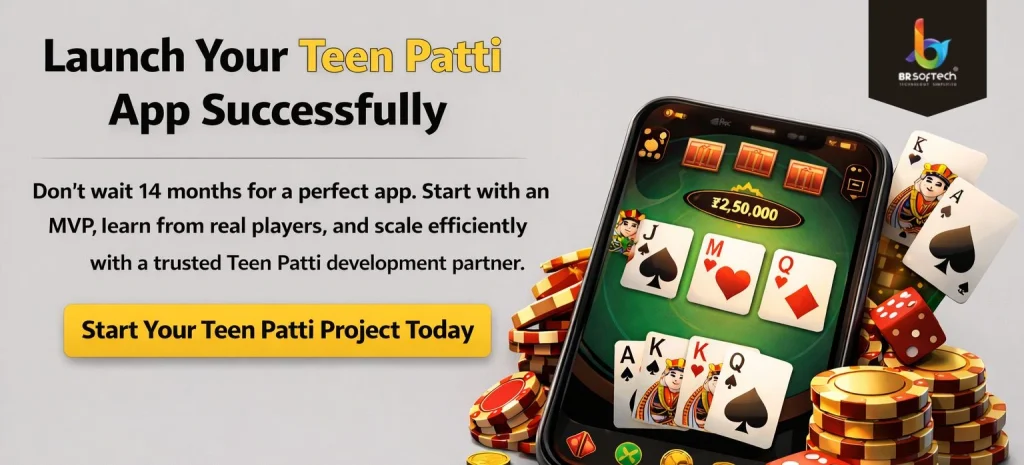
Create a Minimal Viable Product, not a Masterpiece; develop quickly, gain knowledge from real customers, and use your data to build 2.0 based on your data. Those who took 14 months to make a “perfect app” and then didn’t have anyone download it have failed the most.
The cost of development is only the beginning of your conversations; you will invest just as much, or potentially more, in other areas (Marketing, licensing/compliance, operations, and maintain product with ongoing development). Prior to starting to develop a product, model out your 12 months of entire expenses prior to starting to build.
Teen Patti continues to be the easiest of entry points into mobile gaming commercially. You can either develop it yourself or partner with a Teen Patti game development company to kickstart your card game project.
Frequently Asked Questions (FAQs)
Q1. How long would it take to develop a Teen Patti mobile game app?
Ans. Basic MVP will take approximately 2-3 months. A complete Platform will typically take approximately 5-7 months to develop (including Tournament systems, various Versions of Teen Patti, and integrated Payment systems). An enterprise build will take approximately 9-12 months and will have a Custom server architecture.
Q2. Can a Teen Patti app be launched in the U.S.?
Ans. Yes, but there are Caveats. “Real Money Gaming” is regulated by each State in the U.S. Therefore, a Social/free to play version can be launched with relative ease due to the community nature of the game, whereas a Real Money version can only be operated in a State where it is licensed to do so. ALWAYS check with a Gaming Attorney before building a Real Money app in the U.S.
Q3. What is the difference between a White Label versus a Custom Teen Patti solution?
Ans. A White Label Solution is a pre-built platform that you will rebrand or license to your company. This method is less time-consuming (generally speaking, $15k-$40k and limitedly customizable) versus the Custom Solution that you will only have between you and your competitors (generally between $40k-$150k & longer development timeline), and all Intellectual Property will belong to you, therefore you will not have restrictions on scaling your business along the guidelines of the license.
Q4. What will the monthly operating costs be after launch?
Ans. Assuming that your game has a moderate level of players, expect to see $3-$10k/month in expenses associated with your application, which generally consist of the following: Cloud Hosting, Customer Support, Marketing, and minimal Repairs/Fix. If you are developing an application with high concurrent users and/or are planning on implementing an active tournament schedule, expect monthly expenses to significantly increase.
Nitin Garg is a seasoned tech entrepreneur and the visionary founder of BR Softech, a globally recognized leader in game development. With over 13 years of industry experience, he has been instrumental in transforming BR Softech into a powerhouse of innovation, offering cutting-edge solutions in Video Games, Blockchain Games, NFT Game Development, and card games like Poker, Rummy, and Teen Patti.
Nitin’s deep expertise in emerging technologies, combined with a sharp business acumen, has helped position BR Softech as a trusted name in the international gaming arena. Under his leadership, BR Softech has built a global clientele of 3,000+ satisfied customers and scaled a dedicated in-house team of 180+ skilled professionals.