The gaming industry has truly transformed in exciting ways. Players now enjoy the flexibility to switch between devices seamlessly. They might begin a game on their PC during lunch, pick it up on their console in the evening, and then finish with their mobile device before bed. This wonderful shift in player habits has made creating games that work across different platforms not just a bonus but an essential part of thriving in today’s gaming world.
If you’re interested in creating cross-platform games that can attract a wide audience and make the most of your development efforts, this detailed guide will take you through everything you need to know about multi-platform game development in 2026.
What Is Cross-Platform Game Development?
Cross-platform game development refers to creating a single video game that runs seamlessly on multiple platforms, such as PC, consoles, mobile devices, and cloud streaming services, using one shared codebase and adaptable assets.
Instead of building separate native versions for each platform, developers leverage specialized game engines and frameworks that allow a unified project to be deployed across different operating systems, hardware configurations, and input methods.
Cross-platform development differs from native by enhancing efficiency and reach. Native requires separate platform-specific versions, while cross-platform enables a single codebase with optimizations for all platforms.
- Native development requires separate versions for each platform.
- Developers write platform-specific code for iOS, Android, PlayStation, Xbox, and PC.
- Cross-platform development allows writing code once and deploying everywhere.
- It includes platform-specific optimizations.
Why Develop Cross-Platform Games?
The case for multi-platform game development is stronger than ever. The mobile gaming market may reach $775.69 billion by 2032, and PC gaming could surpass $189 billion by 2036. Studios developing for multiple platforms can access these large markets with one product line instead of splitting resources.
Expanded Audience Reach
Developing cross-platform games allows targeting a larger audience across mobile, PC, and console markets, with approximately 2.6 billion mobile, 1 billion PC, and 603 million console players worldwide.
Popular titles like Fortnite have demonstrated the power of cross-platform development, with over 60% of players using cross-play features to join matches with friends on other platforms. Even more impressively, cross-play users show 570% higher engagement, spending significantly more time in-game compared to non-cross-play players.
- Fortnite showcases cross-platform success.
- 60% of players use cross-play.
- Cross-play users are 570% more engaged.
- They spend more time in-game.
Cost and Time Efficiency
While developing cross-platform games may initially take longer than native games, it’s faster and cheaper than creating separate versions or porting later. Hiring cocos2d developers or specialists keeps one codebase instead of multiple builds.
This unified approach offers financial benefits, as developers build one architecture instead of separate native ones, reducing initial costs by 30-50%. Maintenance is simpler with updates deployed across platforms, lowering long-term operational costs.
- Unified approach reduces development costs by 30-50%.
- Single architecture replaces multiple native builds.
- Simplifies ongoing maintenance with single updates.
- Deploys patches and features across platforms simultaneously.
- Eliminates multiple codebases, cutting long-term operational overhead.
Accelerated Time to Market
Cross-platform game development allows simultaneous launches on mobile, PC, and console, enabling quicker market entry and capturing peak player interest to maximize marketing ROI.
Consider launching only on PC first, building an audience before porting to mobile and console later. Market conditions may shift, interest may drop, and competitors may fill the gap. Games like Fall Guys, Among Us, and Fortnite started on limited platforms and later underwent lengthy porting when popular.
- Launch only on PC initially to build an audience.
- Later attempt to port to mobile and console.
- Market conditions and player interest may change.
- Competitors could fill the market gap.
- Examples: Fall Guys, Among Us, and Fortnite started with limited platforms and faced lengthy porting processes after gaining popularity
Expand Your Game to Millions of Players!
Reach mobile, PC, and console gamers with a single game. Let our experts help you build a cross-platform game that maximizes engagement and revenue.
👉 Get Started Today
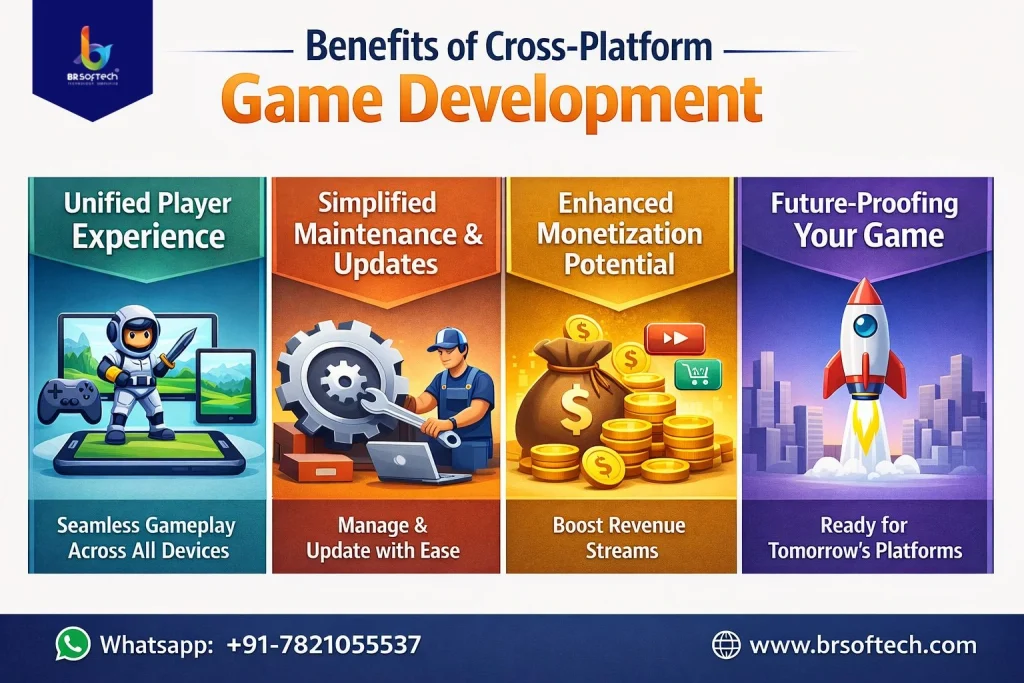
Benefits of Cross-Platform Game Development
Beyond the obvious advantages of reach and efficiency, developing games for multiple platforms offers several strategic benefits that can determine long-term success.
Unified Player Experience
Cross-platform game development services guarantee consistent gameplay, UI, and experience across devices. Players expect seamless sync of progress, achievements, and purchases across mobile and console. Modern services make this integration standard.
Simplified Maintenance and Updates
Maintaining a single codebase reduces technical debt, supports long-term stability, and saves time and money by enabling developers to fix issues once instead of across multiple platforms. This boosts consistency and cuts platform-specific risks.
Enhanced Monetization Potential
Supporting multiple platforms boosts revenue as players on various devices spend more on in-app purchases and subscriptions. Top titles like Minecraft and Fortnite show the strong monetization power of multi-platform access.
Future-Proofing Your Game
The gaming industry evolves quickly, with new platforms and devices emerging. Cloud gaming services like Xbox Cloud Gaming and NVIDIA GeForce Now are changing how players access games. Building with cross-platform frameworks from the start helps your game adapt to future platforms and technologies without full rewrites.
Cross-Platform Game Engines: Choosing Your Development Foundation
The success of your game development project depends on choosing the right engine. Modern cross-platform engines simplify deployment across multiple platforms with tools that abstract platform-specific requirements.
Unity: The Industry Standard
Unity dominates cross-platform game development, powering over 50% of Steam games and more than half of the top 1,000 mobile games on the App Store and Google Play. Its strength lies in supporting multiple platforms, enabling developers to build once and deploy across mobile, desktop, consoles, VR/AR devices, and web browsers.
Unity supports game development for Android and iOS with one-click deployment, a vast asset store, strong 2D/3D features, and C# scripting suited for different skill levels. Its Universal Render Pipeline (URP) optimizes graphics across all platforms.
- Unity allows one-click deployment for Android and iOS.
- Extensive asset store with ready-to-use components.
- Strong 2D and 3D capabilities.
- C# scripting is accessible to developers of all skill levels.
- Universal Render Pipeline (URP) optimizes graphics on all devices.
Unreal Engine: Power and Performance
Unreal Engine has become a favorite among developers for AAA games and projects that need top-tier graphics. With more than half of upcoming next-gen titles being made with Unreal Engine 5, it’s clear that it can handle large open-world environments and provide experiences that match console-quality standards.
Unreal Engine creates visually stunning games with realistic graphics, physics, and high-performance rendering. Its Blueprint system enables designers to develop gameplay without deep programming, offering full C++ access for low-level control. The engine supports all major platforms, including PC, consoles, mobile, and VR/AR.
- Creates stunning, realistic graphics.
- Supports advanced physics and high-performance rendering.
- Blueprint visual scripting enables gameplay design without deep coding.
- Full C++ access for low-level control.
- Deploys to PC, consoles, mobile, and VR/AR devices.
Godot: The Open-Source Alternative
Godot Engine has gained significant traction as a completely free, open-source option for 2D and 3D game development. With no licensing fees, royalties, or runtime costs, Godot appeals to indie developers and small studios working within tight budgets. The engine provides solid cross-platform support for Windows, macOS, Linux, iOS, Android, and web platforms.
- Free, open-source game engine for 2D and 3D development.
- No licensing fees, royalties, or runtime costs.
- Ideal for indie developers and small studios on tight budgets.
- Supports multiple platforms: Windows, macOS, Linux, iOS, Android, and web.
Other Notable Cross-Platform Game Frameworks
Several other frameworks serve specific niches in multi-platform game development. Cocos2d-x remains popular for lightweight, fast-running 2D games, particularly in the mobile space. If you hire cocos2d developers, they can leverage this framework’s excellent performance characteristics and small footprint for mobile-first games.
LibGDX offers a free, open-source Java game development framework with strong cross-platform capabilities. While not as powerful as Unity or Unreal, it provides a solid foundation for mobile and web game development. Similarly, frameworks like Defold and GameMaker Studio cater to specific development needs and skill levels.
Cost of Cross-Platform Game Development
Understanding the investment needed for cross-platform game development helps with budgeting and expectations. Costs vary based on game complexity, target platforms, team size, and timeline.
Key Cost Components
- Game Engine Licensing: Some engines like Unity and Unreal offer free tiers but charge fees for commercial releases or revenue sharing. Unity charges after certain revenue levels, while Unreal takes a 5% royalty after $1 million gross revenue. Godot, open-source, has no licensing costs.
- Development Team Salaries: This usually is the biggest expense. Hiring programmers, artists, designers, animators, and testers for a cross-platform project requires significant costs. Rates differ by area, with North American and Western European developers charging more than Eastern Europe or Asian teams.
- Platform-Specific Requirements: Each platform has unique submission, certification, SDK licensing costs, and approval fees. Development kits may cost thousands of dollars.
- Testing and Quality Assurance: Comprehensive testing across all platforms needs more resources. You must test on actual devices with different hardware to ensure performance and identify platform-specific bugs.
- Post-Launch Support: Ongoing costs include server hosting, updates, marketing, and community management.
Estimated Budget Ranges
For a small indie mobile game using Unity or Godot with a 2-3 person team, costs might range from $50,000-$150,000. A mid-sized game targeting mobile and PC with a team of 10-15 people could cost $500,000-$2 million. Large-scale AAA cross-platform games with teams of 50+ developers can easily exceed $10 million in development costs.
Working with an established cross-platform game development company can help control costs through proven development pipelines, experienced teams, and efficient project management practices.
Best Practices for Cross-Platform Game Development
Successfully developing games that work seamlessly across multiple platforms requires careful planning and adherence to proven best practices.
Design with Platform Differences in Mind
Each platform has unique features to consider. Mobile devices have touchscreens and smaller screens, PCs support keyboard and mouse with more processing power, and consoles use controllers and are for living room viewing. Design your game’s UI, controls, and mechanics to adapt smoothly across these environments.
Implement a unified input system that interprets various controllers, touchscreens, and keyboards. Abstract input controls in your game’s code for device-agnostic mapping, easing new device integration.
Optimize Assets for Multiple Performance Tiers
Asset optimization is crucial for platforms with different capabilities. Mobile devices have less processing power and memory than gaming PCs or consoles. Use level-of-detail (LOD) systems to adjust model complexity, and apply texture compression, mipmapping, and resolution scaling to ensure good visuals and performance across all devices.
Optimize audio assets by using high-quality sounds for critical elements like voices and key effects, and compress ambient sounds and background music more for mobile platforms.
Modular Architecture for Platform-Specific Code
Develop your game using a modular architecture where core gameplay mechanics are separated from platform-dependent code. This approach allows you to update or replace platform-specific modules without affecting core game functionality, making your codebase easier to maintain and scale over time.
Keep platform-specific features like achievements, leaderboards, and social integrations in separate modules that can be swapped out or configured per platform without touching your core game logic.
Comprehensive Testing Across All Platforms
Testing is where many cross-platform projects falter. Use emulators and simulators initially to catch obvious issues, but invest significantly in real-device testing. Each platform can behave differently due to hardware variations, OS versions, and platform-specific quirks that emulators don’t perfectly replicate.
Establish automated testing pipelines that generate builds for every platform regularly. This continuous integration approach helps catch platform-specific bugs early when they’re cheaper and easier to fix.
The Development Process: From Concept to Launch
Understanding the typical workflow for cross-platform game development helps set realistic expectations and ensures you’re prepared for each phase.
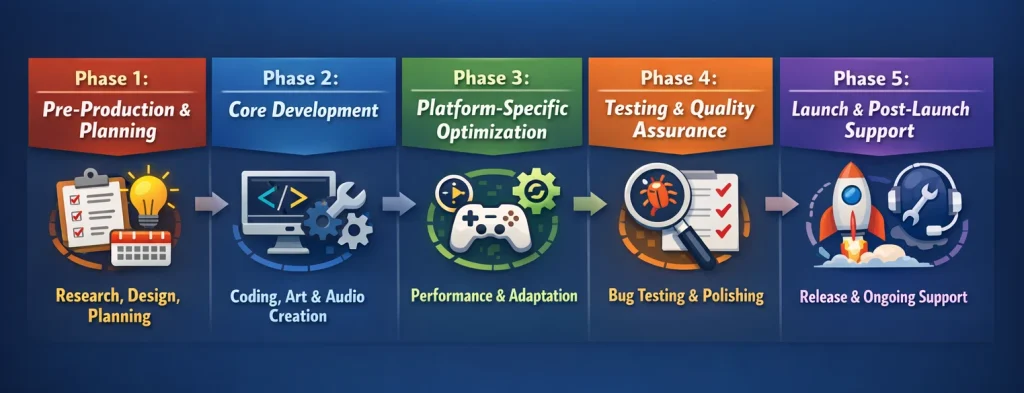
Phase 1: Pre-Production and Planning
Start by clearly defining your target platforms (iOS, Android, PC, PlayStation, Xbox, Nintendo Switch, WebGL) and identifying both shared and platform-specific requirements. Research each platform’s technical specifications, submission guidelines, and player expectations.
Select your game engine based on your project’s specific needs. Consider factors like team expertise, budget constraints, required features, and long-term maintenance needs. Unity generally offers an easier setup for indie developers, while Unreal provides more power for AAA graphics.
Phase 2: Core Development
Build modular UI, gameplay logic, and art pipelines that adapt to multiple screens and hardware profiles. Leverage your chosen engine’s cross-platform tools to write code once and automatically compile for different targets.
Focus on creating scalable systems from the beginning. Design your game architecture to handle varying performance levels, input methods, and screen sizes without requiring major rewrites later.
Phase 3: Platform-Specific Optimization
Once core mechanics are solid, optimize for each target platform. This includes adjusting graphics settings, implementing platform-specific features (like haptic feedback on mobile or achievements on console), and ensuring controls feel natural on each input method.
Performance profiling on actual target devices is crucial during this phase. What runs smoothly on a high-end gaming PC may struggle on mid-range mobile devices, requiring graphics downgrades or optimization.
Phase 4: Testing and Quality Assurance
Modern CI/CD pipelines can auto-generate builds for every platform, dramatically reducing manual work and cutting release cycles. Automated testing combined with device-specific QA ensures consistent stability and performance across all platforms.
Test multiplayer functionality, cross-progression features, and platform-specific integrations thoroughly. Nothing damages player trust more than lost progress or features that don’t work as advertised.
Phase 5: Launch and Post-Launch Support
Coordinate your launch across all platforms simultaneously when possible. Staggered launches can work, but simultaneous release creates more marketing momentum and ensures all players can access your game at once.
Post-launch, monitor performance metrics, player feedback, and crash reports across all platforms. The unified codebase of cross-platform development makes deploying fixes and updates much more efficient than managing multiple separate versions.
Conclusion
Cross-platform game development has become essential for success, enabling players to access games across devices with seamless sync and consistent experiences. By 2026, technology will make this practical for studios of all sizes.
While engaging in comprehensive cross-platform game development services for ambitious multi-platform projects, the key is starting with a clear strategy and the right technical foundation.
Using modern cross-platform game engines, best practices, and a player-first approach allows the development of games that succeed across mobile, PC, and consoles. The future is games that reach players on any device, and cross-platform development makes this possible now.
Frequently Asked Questions (FAQs)
Why should I invest in cross-platform game development for my business? Investing in cross-platform game development expands your game’s reach across mobile, desktop, and consoles without separate codebases, boosting market share and revenue. Launching on multiple platforms simultaneously creates a stronger initial impact and faster ROI.
What are the important cost benefits of cross-platform game development? Cross-platform game development saves costs by reusing code, reducing development, testing, and maintenance efforts. It enables a simultaneous launch across all platforms, speeding up time to market and revenue.
How can I monetize my cross-platform game? Cross-platform games have various monetization methods. In-App Purchases (IAP) let players buy virtual goods and power-ups. Ads include interstitial and rewarded videos for passive income. The Subscription Model offers recurring premium content. The Freemium Model provides free access with paid upgrades. Pay-to-Play charges for game access, effective for top releases.
How do I manage updates and patches for my cross-platform game? Managing updates across multiple platforms is easier with cross-platform development since you maintain a single codebase. When a bug is fixed or a new feature is added, updates can be deployed simultaneously across all platforms. Tools like Unity and Unreal offer streamlined deployment systems that ensure consistency in updates.
Can I achieve cross-play, like players from different platforms playing together? Yes, cross-play is achievable and is a key feature in many successful cross-platform games. To enable cross-play, ensure your game supports cloud saves, has cross-platform account linking, and integrates with platform APIs that allow players to connect regardless of their device.