Augmented Reality has increasingly captured the interest of tech enthusiasts. 2026 has truly been a milestone year for AR technology, with leading companies like Amazon, Apple, and Meta doubling down on expanding their AR offerings. It’s exciting to see AR making waves not only in gaming but across a variety of industries, showing its growing importance and potential.
Augmented Reality app development has gained traction due to its ability to seamlessly blend digital and physical environments. Through 360-degree visuals and advanced computing, AR enables real-time interaction with people regardless of distance. Its innovative solutions have driven significant growth in the past few years.
This blog will share some exciting information about everything related to Augmented Reality. We’ll go through some important points to help you understand it better:
What is AR technology?
What are its applications?
How is it shaping the trends across industries?
Notable AR apps in 2026
These are some of the questions we’ll quickly explore in the upcoming sections. Let’s take a friendly look at AR and see what’s trending in AR apps in 2026.
What is Augmented Reality?
Augmented Reality lets you enjoy digital objects in your real environment, creating an exciting blend of the virtual and the real. It overlays images, sounds, or 3D objects onto the world around you using devices like Oculus, HTC Vive, and Meta’s AR tools. With the help of advanced computer vision and object recognition, AR offers a richer, more engaging experience that allows users to:
Visualize products before purchase
Experience services remotely
Interact with virtual content in physical space
The integration of the physical and digital worlds through AR beautifully showcases how this technology is making a positive impact across various sectors like e-commerce, training, navigation, entertainment, and beyond.
What are the Trends of AR App Development in 2026?
Let’s explore the exciting trends in AR app development for 2026. Since the very first AR game, augmented reality has really expanded into many different fields. Lots of industries are now using this amazing technology to make their products and services more intuitive and engaging.
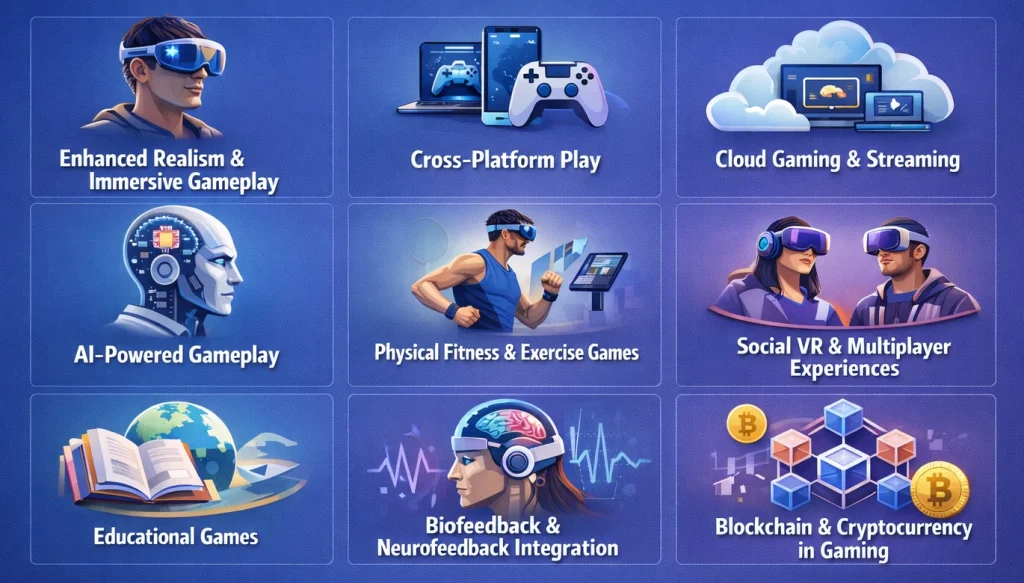
Enhanced Realism and Immersive Gameplay
The race towards photo-realistic graphics and haptic feedback has reached new extremes. Today’s VR headsets boast higher resolution displays, 4K per eye, wider fields of view, and advanced eye-tracking technology.
Haptic suits and gloves can create ASI tactile sensations, enabling users to “feel” virtual objects. Spatial audio provides 360-degree soundscapes that react to head movements, while advanced rendering techniques, such as foveated rendering, make performance more efficient by concentrating computing power where the user is looking.
Photorealistic VR with 4K displays and eye-tracking.
Tactile feedback via haptic suits and gloves.
Spatial audio and foveated rendering enhance immersion.
Cross-Platform Play
Removing the barrier between various VR platforms has become an important requirement. Meta Quest owners can now connect with players on PlayStation VR or PC-based platforms to create virtual public spaces together.
They can also do the same when it comes to AR applications, as experiences span seamlessly between smartphones, smart glasses, and head-mounted displays. Software developers can now employ universal standards and application programming interfaces to make their content as broad as possible.
Break down platform barriers to enable cross-compatibility.
Connect users across VR and AR devices seamlessly.
Use universal standards and APIs for broader content reach.
Cloud Gaming and Streaming
Cloud-based VR relies on remote processing of graphics and streaming them into lightweight VR headsets. This renders local hardware requirements unnecessary. Technologies include Meta’s cloud streaming and enterprise offerings.
This supports high-quality VR on mobile devices. This is even possible through low-latency 5G connectivity. The preceding technology allows for instant access to heavy apps with no need for downloads or installations. This is because 5G connectivity addresses latency issues. Cloud gaming and streaming:
Eliminates the need for powerful local hardware.
Utilizes Meta’s cloud streaming and enterprise solutions.
Supports high-quality VR on mobile devices.
Enables low-latency experiences via 5G connectivity.
Allows instant access to heavy apps without downloads or installs.
5G addresses latency for seamless VR streaming.
AI-Powered Gameplay
The field of artificial intelligence is transforming the way we engage with virtual reality. AI-powered NPCs (non-player characters) demonstrate realistic behavior and interactions. The concept of content generation leads to user-specific environments and situations.
Moreover, machine learning enables dynamic difficulty adjustment according to user performance. Natural language processing makes it possible to interact with virtual reality using speech commands and in a very natural-sounding way.
Natural language processing enables speech-based interactions.
Physical Fitness and Exercise Games
Fitness in VR has evolved to the point where it has become a viable substitute for regular physical exercise. The games Beat Saber, Supernatural, and FitXR are some virtual alternatives to physical exercise.
There are boxing simulators and dancing games. This has found validation in the fact that the calories burned in VR physical activity are the same as those in conventional exercises. The data provided by fitness trackers further reinforces this.
VR fitness has become a credible substitute for traditional exercise.
Popular games include Beat Saber, Supernatural, and FitXR.
Boxing simulators and dancing games are also available.
Calories burned in VR match those in conventional workouts.
Fitness trackers support this data with additional validation.
Social VR and Multiplayer Experiences
Virtual worlds are now truly social platforms that people use for work and play. These social platforms include VRChat, Horizon Worlds, and AltspaceVR, with millions of users attending concerts, meetings, and social events in virtual worlds.
Through avatars with proper facial and body expressions, people form emotions and relationships. There are now virtual economies that enable people to create and trade digital items.
Virtual worlds are social platforms for work and play.
Examples include VRChat, Horizon Worlds, and AltspaceVR.
Millions attend virtual concerts, meetings, and events.
Virtual avatars foster emotions and relationships.
Virtual economies allow the creation and trading of digital items.
Educational Games
AR and VR are revolutionizing the education sector by allowing students to touch and feel concepts that previously remained abstract. Medical students are able to perform surgery on virtual patients in risk-free environments.
History is made alive as students get to enter the virtual reconstruction of ancient civilizations. Chemistry students are able to perform actions on molecules in 3D. Language students experience the culture of the language they are learning.
AR and VR transform education by making concepts tangible.
Medical students perform virtual surgeries safely.
History comes alive through virtual recreations of ancient civilizations.
Chemistry students manipulate molecules in 3D.
Language learners immerse themselves in cultural experiences.
Biofeedback and Neurofeedback Integration
AR/VR experiences are now affected by the physiological condition of the user. Heart rate tracking, EEG headbands, and stress detectors can change the game’s difficulties or scenarios according to the anxiety levels, concentration, or excitement of the user. This leads to the development of medical uses related to the treatment of PTSD patients.
Games can be used to manage emotional control through the representation of the player’s mental condition. Doctors can employ these to form a diagnosis or treatment related to mental conditions.
AR/VR experiences now adapt to the user’s physiological state.
Heart rate, EEG headbands, and stress detectors adjust scenarios based on anxiety, focus, or excitement.
Enables medical applications for PTSD treatment.
Games can help manage emotions by reflecting mental states.
Healthcare professionals use these tools for diagnosis and therapy.
Blockchain and Cryptocurrency in Gaming
NFTs and blockchain technology offer true ownership of these virtual goods and are transferable across games and platforms. Players invest in virtual properties, rare items, and collectibles that hold true-world value. The play-to-earn model enables gamers from developing countries to earn money.
Decentralized virtual reality environments give users a say in how platforms are developed. The debate around environmental factors, speculation, and ease of accessibility continues.
NFTs enable true ownership and transferability of virtual goods.
Players can invest in virtual assets with real-world value.
Play-to-earn allows gamers in developing countries to make money.
Decentralized virtual worlds give users platform control.
Ongoing debates focus on environmental impact, speculation, and accessibility.
What are Some of the Notable AR Apps?
Many developers craft augmented reality apps to offer users the best solutions to their problems. Here are some of the top examples of AR apps that stand out.
AcrossAir: AR-based location finder
Google Sky Map: Explore stars and constellations in real time
Pokémon Go: Continues to evolve as a benchmark AR game
Augmented reality apps help you bring digital creation to life and provide a great experience.
Augmented reality has moved beyond just gaming; it’s now an important tool across many business sectors. Creating engaging and creative content has become essential to delight consumers. With the integration of blockchain, AI, VR, and web technologies, AR is more powerful than ever. It’s now commonly used to provide richer, smarter, and more immersive experiences than ever before.
If you’re looking to elevate your business, consider integrating AR technology into your apps or services. Reaching out to an AR game development company can be a great way to learn how to adopt this exciting technology, boosting innovation, engaging your customers, and staying ahead in the competitive landscape.
Frequently Asked Questions (FAQs)
What role does Augmented Reality (AR) play in marketing?
AR beautifully connects the physical and digital worlds. It brings in 3D models, animations, and interactive features to make visualization clearer and more engaging. Thanks to this technology, users can enjoy a more immersive and hands-on experience with products or services.
How does AR benefit marketers and brands?
Augmented reality helps marketers increase revenue by providing users with better engagement options, virtual product try-ons, and creating memorable experiences. These personalized interactions significantly boost conversion rates.
Do consumers need special devices to experience AR?
No, 2026 allows users to access AR experiences through smartphones and tablets (via apps or browsers using WebAR). However, there are designated AR headset/glass devices as well, like Apple Vision Pro, Meta Quest, that provide an unmatched experience.
Which industries are using AR marketing the most in 2026?
Industries widely using AR in marketing include: Retail & Fashion (try-ons, virtual stores) Furniture & Home Decor (in-room product previews) Beauty & Cosmetics (virtual makeup application) Automotive (interactive vehicle demos) Real Estate (3D property tours) Entertainment & Gaming (AR-based campaigns)
Nitin Garg is a seasoned tech entrepreneur and the visionary founder of BR Softech, a globally recognized leader in game development. With over 13 years of industry experience, he has been instrumental in transforming BR Softech into a powerhouse of innovation, offering cutting-edge solutions in Video Games, Blockchain Games, NFT Game Development, and card games like Poker, Rummy, and Teen Patti.
Nitin’s deep expertise in emerging technologies, combined with a sharp business acumen, has helped position BR Softech as a trusted name in the international gaming arena. Under his leadership, BR Softech has built a global clientele of 3,000+ satisfied customers and scaled a dedicated in-house team of 180+ skilled professionals.