The AR game development cost in the year 2026 can vary greatly. Based on the opinions of industry experts at present, the development cost of an AR game can be anywhere from $20,000 to $300,000 or even more for some complex multi-user games that cost $500,000 or even more.
For businesses exploring AR game development solutions, understanding this cost breakdown becomes the foundation for strategic planning. A basic AR game with simple overlays and marker-based interactions costs between $20,000-$60,000, while mid-level applications featuring markerless AR, 3D object tracking, and moderate multiplayer functionality range from $60,000-$120,000. Advanced AR games incorporating GPS integration, extensive multiplayer capabilities, and high-end graphics can command budgets from $120,000-$300,000 or higher.
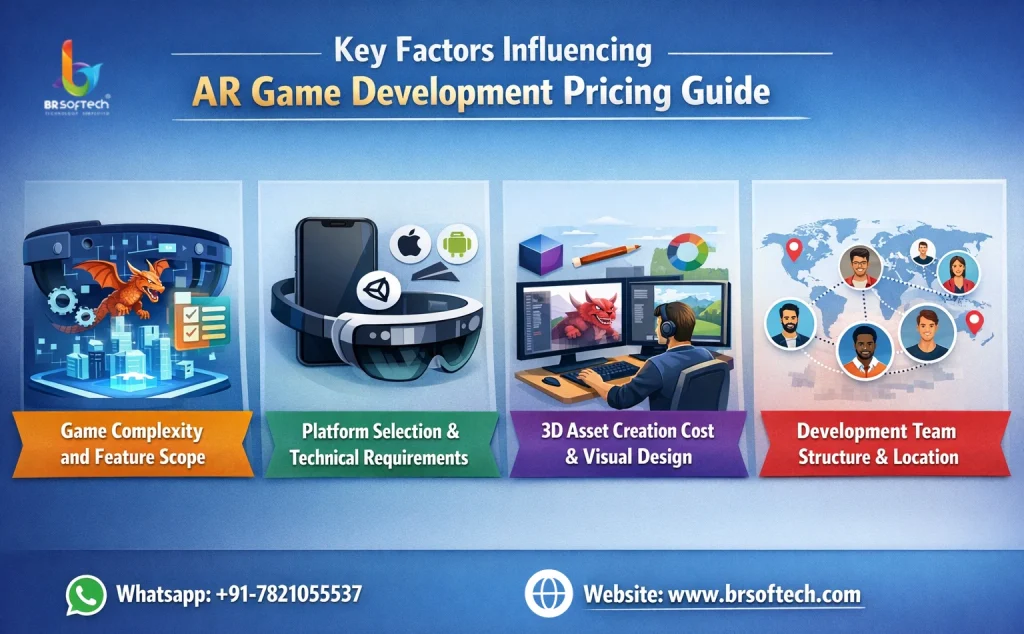
Key Factors Influencing AR Game Development Pricing Guide
Let’s look at the important factors that influence AR game development. These factors are taken into consideration by all the top game development companies operating in the augmented reality sector.
Game Complexity and Feature Scope
The complexity of your AR game truly influences the development costs. For example, simple AR apps that feature basic elements like object placement, AR filters, and simple animations usually need fewer resources and take less time to develop. These kinds of projects often include 1-5 AR models and core functions such as rotating objects, capturing photos, and straightforward interactions.
Moderate complexity games add multiplayer, advanced UI/UX, cloud, and custom assets, requiring more sophisticated architecture and longer development. Complex AR games with open worlds, 5G, multiplayer, blockchain, and e-sports-level performance are the most advanced and costly.
Platform choices majorly affect AR game development costs. Using ARKit for iOS or ARCore for Android is the cheapest, costing $20,000-$80,000 for basic to moderate apps. Cross-platform with Unity or Unreal boosts initial costs by 20-30% but offers wider reach and better ROI.
Each platform has specific technical requirements. iOS development commands premium pricing due to Apple’s standards and optimization needs across iPhone and iPad models. Android development needs testing on many device configurations, raising AR game testing & QA costs by 15-25%. Supporting both platforms, though initially more expensive, offers better market reach and revenue potential.
iOS development: premium pricing, strict quality standards, optimization for various iPhone and iPad models.
Android development: testing across multiple device configurations, increasing AR game testing & QA costs by 15-25%.
Supporting both platforms: higher initial cost, better market penetration, and increased revenue potential.
3D Asset Creation Cost and Visual Design
The 3D asset creation cost is a major part of AR game budgets, usually 25-30%. Basic models with simple shapes cost $5,000-$10,000, while detailed, high-quality models cost $15,000-$30,000.
Character design and animation are costly, with custom characters costing $10,000-$50,000 based on complexity and interactions. Environment design for immersive AR adds $15,000-$40,000, including architectural, natural, and interactive elements. Games with photorealistic graphics and advanced rendering, like ray tracing, demand premium prices due to specialized skills.
Custom character design and animation: $10,000–$50,000, depending on complexity.
Photorealistic graphics and ray tracing: premium pricing due to specialized expertise.
Development Team Structure and Location
The composition and location of the development team really matter when it comes to estimating the cost of an AR game. For example, North American developers usually charge between $100 and $200 an hour, while Western European teams range from $80 to $150 per hour. Eastern European developers often work for $40 to $80 an hour, and Asian development teams generally charge between $25 and $60 per hour.
A typical AR game team includes project managers, AR developers (ARKit/ARCore), 3D artists, UI/UX designers, backend developers, and QA specialists. For a moderate project, expect 4-8 months with 5-10 team members, totaling 800-2,000 hours and costing $40,000-$160,000 based on location and expertise.
AR development team: project managers, ARKit/ARCore developers, 3D artists, UI/UX designers, backend developers, QA specialists.
Project timeline: 4-8 months.
Team size: 5-10 professionals.
Development hours: 800-2,000.
Cost: $40,000-$160,000, depending on location and expertise.
The budget for developing an AR game can be divided into different categories. Let’s dissect them one by one.
Pre-Development Phase ($5,000-$20,000)
The pre-development phase sets project foundations via market research, competitor analysis, concept development, and technical studies. It involves creating game design documents, prototypes for investors, wireframes for user journeys, UI/UX mockups, and branding assets like logos and icons.
Investing in pre-development prevents costly revisions later. Many successful AR games credit thorough planning, identifying audience preferences, monetization strategies, and technical constraints beforehand for their market success.
Investing in pre-development cuts revision costs.
Successful AR games rely on thorough pre-production planning.
Planning identifies the target audience, monetization, and technical constraints before development.
Core Development Phase ($30,000-$200,000)
Core development consumes 60-70% of the AR game budget, covering AR functionality like marker recognition, markerless tracking, 3D model integration and optimization, game mechanics, multiplayer infrastructure, backend API, database, payment gateway, and social features.
Marker-based AR games usually cost $30,000-$60,000, while advanced markerless AR apps with computer vision are $50,000-$150,000. Location-based AR games like Pokémon Go need over $120,000-$250,000 due to complex infrastructure and testing.
Marker-based AR games: $30,000-$60,000.
Markerless AR with advanced vision: $50,000-$150,000.
Location-based AR (e.g., Pokémon GO): $120,000–$250,000+ due to complex infrastructure and testing.
Testing and Quality Assurance ($10,000-$40,000)
AR game testing & QA costs usually make up 10-15% of development expenses. Testing involves device compatibility across smartphones and tablets, lighting conditions affecting AR recognition, environmental factors, network performance under various connectivity, and optimization of battery and memory use.
Professional QA teams perform various tests, including functional, performance, security, user acceptance, and beta testing with real users. The complexity of AR technology requires rigorous protocols to ensure consistent performance in real-world conditions, making this investment essential for a successful market launch.
QA teams perform functional, performance, security, user acceptance, and beta testing with real users.
AR technology’s complexity requires rigorous testing.
Ensures consistent performance in diverse conditions.
Critical investment for successful market launch.
Post-Launch Support and Updates ($5,000-$30,000 annually)
Successful AR games require ongoing maintenance, updates, and improvements. Post-launch costs include server hosting and maintenance ($500-$5,000 monthly), bug fixes and performance optimization, content updates and new feature additions, security patches and compliance updates, customer support infrastructure, and analytics integration and monitoring.
Many developers dedicate 15-20% of initial development costs yearly to support, maintaining user engagement, solving issues, and updating the game for platform and user needs.
Developers allocate 15-20% of initial costs annually for post-launch support.
Supports user engagement and issue resolution.
Adapts the game to platform updates and user expectations.
AR Multiplayer Game Pricing Considerations
Let’s understand the AR multiplayer game pricing considerations through a table.
Aspect
Description
Estimated Cost / Impact
Multiplayer Development Complexity
Multiplayer AR games require networking architecture, real-time synchronization, matchmaking algorithms, anti-cheat systems, scalable servers, and player communication systems.
Adds 30–50% to single-player development cost
Development Cost Example
A basic single-player AR game costs around $50,000. Adding multiplayer features increases the cost.
$65,000 – $75,000 for basic multiplayer; advanced features like voice chat, tournaments, team gameplay, and leaderboards push costs higher
Backend & Server Infrastructure
Multiplayer games require scalable cloud servers and ongoing backend operations to support concurrent users and real-time gameplay.
$1,000 – $10,000 per month for moderate success; viral games require higher scalable infrastructure for peak traffic
Technology Stack Impact on AR Game Features Cost Impact
The AR game features a cost impact that varies significantly based on chosen technology platforms and development tools. Unity and Unreal Engine dominate AR game development, each offering distinct advantages and pricing structures.
Unity
Most popular choice for mobile AR development.
Supports AR Foundation for both ARKit (iOS) and ARCore (Android).
Extensive Asset Store reduces custom development costs by 20–40%.
Pricing: Free for personal licenses, $185/month for professional licenses, $4,400/year for enterprise solutions
Unreal Engine
Ideal for high-fidelity AR experiences with superior graphics.
Free for development; 5% royalty on revenue exceeding $1 million per product.
Projects that require photorealistic graphics often justify the higher cost.
Requires more specialized expertise and higher developer rates.
Additional AR Development Tools
Version Control Systems: Git, Perforce, etc.
ARCore & ARKit SDKs: Free, but platform-specific development is required.
3D Modeling Software: Blender (free), Maya ($1,875/year)
Regional Cost Variations and Outsourcing Options
Geographic location dramatically affects AR game development expenses. Partnering with an experienced game app development company in cost-effective regions can reduce expenses by 40-60% while maintaining quality standards.
North American development studios in the US and Canada offer premium quality with extensive experience, but command the highest rates at $100,000-$300,000+ for moderate AR projects.
Western European studios in the UK, Germany, and France provide excellent quality at $80,000-$200,000 for similar projects.
Eastern European countries, including Poland, Ukraine, and Romania, offer optimal price-quality ratios at $50,000-$120,000.
Asian development hubs in India, the Philippines, and Vietnam provide the most affordable options at $30,000-$80,000 for moderate complexity projects.
When evaluating outsourcing, consider factors beyond rates like communication, cultural fit, time zones, portfolio, expertise, and support. Many successful AR games use hybrid approaches combining onshore management with offshore resources.
Cost Optimization Strategies for AR Game Development
Let’s understand how we can optimize the cost for strategic AR games. One of the important steps is to develop an MVP product; let’s check this along with other strategies.
Begin With a Minimum Viable Product
Developing a Minimum Viable Product (MVP) is the most cost-effective strategy. It concentrates on core AR features, costing 40-60% less than full versions. This enables market testing, validates key concepts before large investments, guides feature prioritization, and supports iterative development with user feedback.
Successful AR game startups often launch MVPs at $25,000-$60,000, gather user insights, secure additional funding based on market validation, and then expand features strategically based on actual user demand rather than assumptions.
Leverage Asset Stores and Templates
Unity Asset Store and Unreal Marketplace provide thousands of 3D models, textures, scripts, controllers, UI components, and AR tools. Using quality assets shortens development time by 30-50% and maintains standards. Custom tweaks create a unique look without starting from scratch.
Implement Agile Development Methodology
Agile development with short sprints, feedback, and iterations helps find issues early, cut late revisions, keep budget flexibility, and speed up time-to-market. Stakeholder reviews ensure alignment and allow course corrections before big resource investments.
Focus on a Single Platform Initially
Launching on a single platform (iOS or Android) cuts initial development costs by 40-50% compared to a cross-platform release. This allows faster market entry, focused marketing, platform-specific optimization, and revenue for expansion. Success on one platform supports expansion to others.
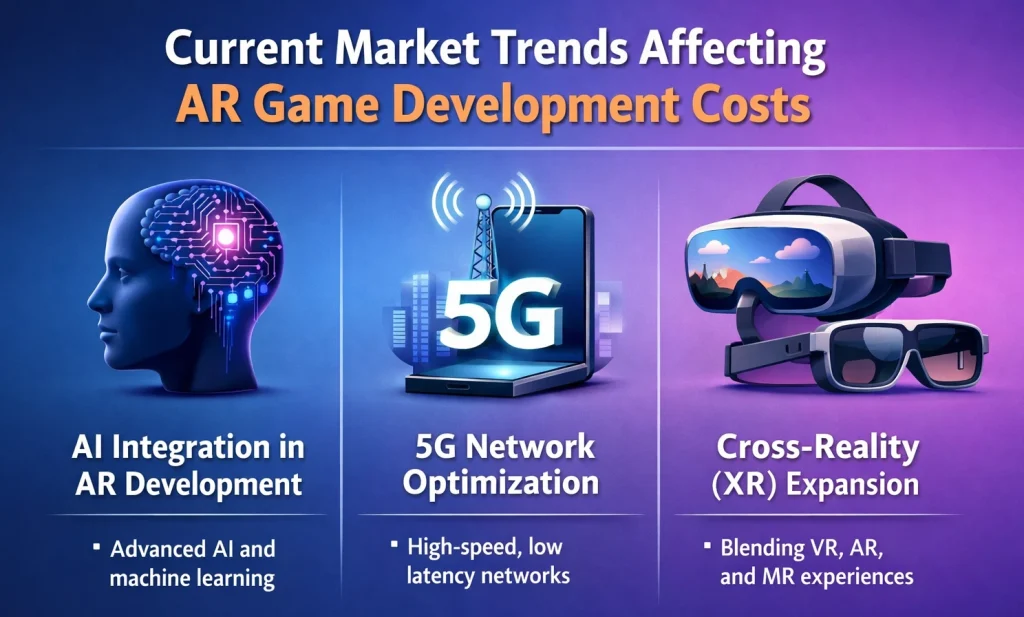
Current Market Trends Affecting AR Game Development Costs
Let’s look at some of the current market trends in AR game development. We will also discuss how it affects the costs while following these trends.
AI Integration in AR Development
Artificial intelligence tools are transforming AR game development workflows in 2026. AI-powered asset generation reduces 3D modeling time by 30-50%, procedural content creation produces diverse environments efficiently, automated testing detects issues faster, and NPC behavior programming becomes more sophisticated with less manual effort.
AI cuts 3D modeling time by 30-50%.
Procedural content creates diverse environments efficiently.
Automated testing speeds up issue detection.
NPC programming becomes more sophisticated with less effort.
AI reduces costs but adds licensing and integration expenses.
5G Network Optimization
5G connectivity enables ambitious AR with lower latency, better multiplayer, cloud rendering, and richer streaming. But, optimizing for 5G adds development complexity and testing, potentially raising costs by 10-15%, while enabling new gameplay possibilities.
5G enables ambitious AR with lower latency.
Supports multiplayer, cloud rendering, and richer streaming.
Optimization increases complexity, testing.
Costs up 10-15%.
Unlocks new, previously infeasible gameplay.
Cross-Reality (XR) Expansion
The convergence of AR, VR, and mixed reality opens cross-platform opportunities. Supporting multiple formats raises initial costs by 25-40% but targets emerging markets and various hardware, including smartphones, AR glasses, VR headsets, and future XR devices.
AR, VR, and mixed reality convergence enables cross-platform experiences.
Supporting multiple formats raises initial costs by 25-40%.
Enhances product positioning in emerging markets.
Compatible with smartphones, AR glasses, VR headsets, and future XR devices.
Return on Investment and Revenue Potential
Understanding AR game development costs involves evaluating potential returns. The global AR gaming market is rapidly expanding, with significant growth expected through 2027. Successful AR games earn revenue via in-app purchases, subscriptions, advertising, sponsorships, branded content, and real-money gaming where legal.
Top AR mobile games generate monthly revenues from $50,000 for niche titles to millions for market leaders. Pokémon GO, despite being years old, still generates over $1 billion annually, showing the revenue potential of successful AR games.
Conclusion
The AR game development cost in 2026 reflects the sophisticated technology, creative assets, and technical expertise required to create immersive augmented reality experiences. Understanding the cost to develop an AR game requires careful analysis of project requirements, feature complexity, platform choices, and team composition.
Starting with MVP development, leveraging cost-effective development resources, utilizing asset stores strategically, and implementing agile methodologies helps optimize the AR game development budget breakdown while maintaining quality standards. For businesses and entrepreneurs entering the AR gaming market, partnering with experienced development teams familiar with AR technology intricacies, platform-specific requirements, and market dynamics proves essential.
Frequently Asked Questions (FAQs)
How much does it cost to develop an AR game?
The cost of developing an AR game varies greatly depending on complexity, features, graphics, platforms, and team location. Basic AR games typically cost between $20,000 and $50,000, mid-level games range from $50,000 to $150,000, and more sophisticated AR games with advanced features and APIs can cost over $200,000 to $500,000 or higher.
What factors influence the cost of AR game development?
Several important factors influence the overall development cost, including the game’s type and complexity, the level of graphics, the features you choose, the developer’s location and rates, the technology stack, and after-launch support and maintenance.
Does developer location affect AR game pricing?
Developer rates vary by region; hiring in North America or Western Europe generally costs more than in India or Southeast Asia. Choosing a location impacts the budget.
What additional costs should I expect beyond development?
Beyond development, AR games incur ongoing costs like server infrastructure, backend maintenance, cloud services, marketing, user acquisition, software licenses, and QA testing across devices.
Nitin Garg is a seasoned tech entrepreneur and the visionary founder of BR Softech, a globally recognized leader in game development. With over 13 years of industry experience, he has been instrumental in transforming BR Softech into a powerhouse of innovation, offering cutting-edge solutions in Video Games, Blockchain Games, NFT Game Development, and card games like Poker, Rummy, and Teen Patti.
Nitin’s deep expertise in emerging technologies, combined with a sharp business acumen, has helped position BR Softech as a trusted name in the international gaming arena. Under his leadership, BR Softech has built a global clientele of 3,000+ satisfied customers and scaled a dedicated in-house team of 180+ skilled professionals.