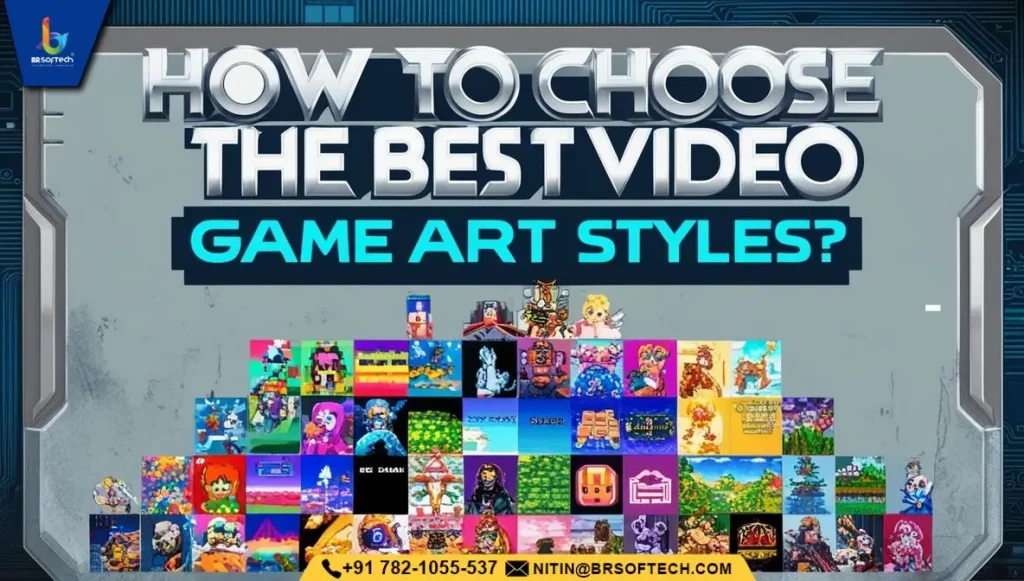
As we say, first impression is the last impression; the same goes for the games that we play. At first, we are all attracted to the game’s look, which includes character, lightning, colors, etc. Every game’s look differs from one another. As the gaming world is evolving, it is introducing new video game art styles in the market, which gain traction from players and entrepreneurs as well. The highlight of this blog is different 2D and 3D art styles that captivate the fierce gamers. Let’s check them out.
The game art styles play an important role as they represent captivating visuals, the tone of the game, and overall player experience. Below are the points why game art styles are important in your title:
First Impressions and Visual Identity
Brief’s Game’s Theme and Story
Improves Player’s Impression
Affects Gameplay and Readability
Practical and Budget Considerations
What are 2D Game Art Styles?
Earlier, with the low graphic capabilities of software, the games couldn’t attract many users. However, with the advancement of technology, game designers can now add endless variety and creativity to the basic game environment. Below is the list of the best 2D game art styles.
Hand-Drawn 2D Art
Cutout Art
Pixel Art
Flat Art
Doodle Art
Monochromatic Art
Cel Shading Art
Hand-Drawn 2D Art
Hand-drawn art gives your game a warm, emotional, and artisanal feel. Every frame looks like it was painted manually, giving the game a storytelling vibe similar to children’s books, animations, and indie films. This style is expressive and adds personality, but it requires skilled illustrators and more production time.
Suitable For:
Narrative-driven games
Storybook or comic-inspired adventures
Indie titles focusing on emotion
Educational and kids’ games
Game Examples:
Hollow Knight
Cuphead
Ori and the Blind Forest
Cost:
Medium to High. Depends heavily on the number of animations (frame-by-frame art is expensive). Skilled illustrators raise the cost.
Cutout Art
Cutout art uses layered pieces of 2D characters or objects that are moved like puppets. Instead of drawing every frame, animators create “body parts” and rig them for motion. It’s visually appealing and cheaper than full hand-drawn animation.
Suitable For:
Adventure games
Point-and-click games
Lean-budget indie studios
Mobile games with light animation
Game Examples:
South Park: Stick of Truth
Don’t Starve
Paper Mario (mix of 2D cutout aesthetics)
Cost:
Low to Medium. Costs mostly depend on character rigging and asset variety, not frame count.
Pixel Art
Pixel art recreates the retro 8-bit or 16-bit feel but with modern details. It’s nostalgic yet flexible. Pixel art can be simple (think early Mario) or extremely detailed (like modern indie RPGs).
Suitable For:
Retro-themed games
RPGs and Platformers
Mobile games
Studios with small budgets
Game Examples:
Stardew Valley
Dead Cells
Blasphemous
Cost:
Low to Medium. Simple pixel art is cheap. However, high-detail pixel art with fluid animation becomes more expensive.
Flat art uses clean shapes, minimal shading, and bold colors. It is easy to read on small screens, making it one of the most popular styles for modern mobile games.
Suitable For:
Hyper-casual and casual games
Educational apps
Puzzle games
UI-heavy mobile titles
Game Examples:
Monument Valley
Alto’s Odyssey
Two Dots
Cost:
Low. Simple shapes, fewer details, and fewer animations are needed to keep production affordable.
Doodle Art
Playful, irregular, and intentionally ‘imperfect’, doodle art looks like sketches made in a notebook. It adds a quirky, humorous feel and stands out among polished mobile titles.
Suitable For:
Humor-based games
Casual mobile apps
Indie games with quirky personalities
Game Examples:
Doodle Jump
Draw a Stickman
Scribblenauts (mixed-doodle inspired look)
Cost:
Low. Simple lines and rough sketches keep production costs down.
Monochromatic Art
This style uses one color or a limited palette (like black and white). It creates a mysterious, dramatic, or minimalist look. Lighting plays a huge role in how the game feels.
Suitable For:
Horror and noir games
Atmospheric puzzle games
Art-house indie titles
Game Examples:
Limbo
Inside
Minit
Cost:
Low to Medium. Fewer colors simplify asset creation. But high-quality lighting and animation can raise costs.
What are 3D Game Art Styles?
3D game art style provides a realistic environment in the game. The 3D characters and the overall game story look like animated films that are enjoyed by the players. Below is the list of the most used 3D game art styles.
Cel-Shading Art
Cel-shading blends 2D comic aesthetics with 3D character models. Think bold outlines, smooth gradients, and a hand-painted visual feel. It gives games a vibrant cartoon look while using 3D pipelines.
Suitable For:
Action and adventure titles
Anime-inspired games
Open-world RPGs
Stylized shooters
Game Examples:
Genshin Impact
Borderlands
Legend of Zelda: Breath of the Wild
Cost:
Medium to High. Required strong lighting setups, stylized shaders, and high-quality 3D artists, and some of the gaming studios have to be in the queue.
Realistic / Photorealistic Art
As the name says, this art style replicates the real-world environment with high-fidelity textures, accurate lighting, and lifelike proportions. Its main aim is to focus on detailed shading, believable environments, and realistic materials.
Suitable For:
FPS and action titles
Cinematic story-driven games
Open-world adventures
Sports and simulation games
Game Examples:
Red Dead Redemption 2
The Last of Us Part II
Call of Duty: Modern Warfare
Stylized 3D Art
The USP of stylized 3D art is, it integrates vibrant colors rather than realistic proportions. A perfect blend of cartoon-like elements and visual storytelling, creating a memorable and timeless aesthetic that doesn’t rely on realism.
Suitable For:
Hero shooters
Family-friendly adventures
RPGs and fantasy worlds
Battle royale games
Game Examples:
Fortnite
Overwatch
Valorant
Low-Poly Art
With the use of minimal polygon counts, flat colors, and simple geometry, it believes in providing simplicity, yet provides a captivating world that feels clean and atmospheric. Perfect for indie developers or projects focused on mood rather than detail.
Suitable For:
Indie adventure games
Mobile games
Strategy and survival titles
Atmospheric exploration games
Game Examples:
Journey
Valheim
Astroneer
5. Hand-Painted 3D Art
If you want to provide a comic-like experience to your game, then hand-painted 3D art can be an appropriate choice for your project. The characters are styled with artistic brushstrokes, soft shading, and fantasy-friendly color palettes.
Suitable For:
Fantasy RPGs
MOBA games
Adventure and platformers
Mobile RPGs
Game Examples:
World of Warcraft
Dota 2
Torchlight II
6. Voxel Art
In voxel art-based games, small cubes like blocks to form characters, environments, and props, giving a blocky yet charming aesthetic look. Despite its simplicity, voxel art allows highly dynamic environments and easy modular building.
Suitable For:
Sandbox games
Survival and crafting titles
Casual and mobile games
Creative building games
Game Examples:
Minecraft
Trove
Voxatron
How to Choose a Game Art Style for Your Game?
Choosing the right art style can make or break your game in this competitive gaming market. It helps players to understand, feel, and connect with your game. The best styles depend on what type of game you wish to create for your players.
Decide Your Game Genre And Theme
Your game’s core idea can decide the type of game environment and style you need for your game. Different games require different art styles. To decide on a theme, ask these three questions:
What emotional tone do you want?
Does the world lean toward fantasy realism art styles or exaggerated stylized visuals?
Will the story or characters benefit more from realism or imagination?
Match Art Style With Your Budget and Team Skill
Each art style costs differently; some may cost reasonably, while others may shake your budget. Satisfying your players with cool themes is good, but budget is also very important.
Think about:
Time and cost limitations
Your artists’ strengths
Animation complexity
Technical performance requirements
Follow Latest Video Game Art Styles
Today’s different types of gamers are very savvy; they always prefer the latest art styles and try to incorporate the newest type of art style into their games. The current trends include:
Hybrid PBR stylized worlds
Minimalist and low-poly styles for indie games
Anime-inspired cel-shading
High-fidelity realism for AAA titles
AR/VR-friendly simplified aesthetics
What are the Best Video Games With Unique Art Styles?
Every game is specific in its own way, but only a few can be on the top list. These games do not even perform well, but also include great art styles. Here is the list of games by which, as an entrepreneur, you will get an idea:
Game Title
Art Style
What Makes It Unique
Cuphead
1930s Cartoon / Hand-Drawn
Fully hand-drawn animation inspired by vintage 1930s cartoons
Journey
Minimalist / Low Poly
Simple shapes with atmospheric lighting and emotional tone
Borderlands
Cel-Shading
Comic-book outlines and stylized characters
Hollow Knight
Gothic 2D
Hand-drawn environments with a dark fantasy mood
Okami
Sumi-e Ink Painting
Brushstroke textures based on Japanese traditional art
Ori and the Blind Forest
Painterly Fantasy
Lush hand-painted scenes with glowing, ethereal lighting
The Legend of Zelda: Wind Waker
Toon-Shaded 3D
Bright cel-shading with expressive animations
Gris
Watercolor Art
Soft watercolor illustrations blend with storytelling
Hades
Graphic Novel Style
Sharp character designs and bold, high-contrast colors
Inside
Monochrome Minimalism
Dark muted palette with eerie lighting composition
Minecraft
Voxel Art
Block-based world with limitless creativity
Firewatch
Stylized Realism
Painterly national park visuals with warm color schemes
Darkest Dungeon
Gothic Ink 2D
Heavy shadows, ink-stroke textures, and comic-horror vibes
Sea of Thieves
PBR Stylized 3D
Stylized shapes with realistic PBR lighting and oceans
Katamari Damacy
Abstract / Surreal
Bright geometric shapes and whimsical, dreamlike design
Final Words
With the advancement of technologies, the game art styles are also upgrading. The art styles are responsible for increasing the player retention rates. Visuals attract the maximum number of players towards the game. In this blog, you have witnessed the most trending and used game art styles. If you are an entrepreneur and want to integrate any one game art style in your game, then carefully choose a reputable game development company that can efficiently integrate it into your game.
Frequently Asked Questions
Q.1 Which game art styles provide the best return on investment (ROI)?
Ans: Stylized 3D, low-poly, flat art, and pixel art generally offer the best ROI because they are cheaper to produce, age well, and appeal to a wide audience, especially on mobile.
Q.2 What art style is most affordable for a startup or small studio?
Ans: Low-poly, 2D flat art, cutout art, and simple pixel art are budget-friendly since they require fewer resources, smaller teams, and faster production cycles.
Q.3 Which art styles are best for mobile gaming startups?
Ans: Mobile-friendly styles include flat art, low-poly, stylized 3D, and 2D cutout art because they provide high clarity, low performance demands, and faster production at lower cost.
Q.4 How do AR and VR trends affect my choice of art style?
Ans: AR/VR requires optimized, lightweight assets. Stylized 3D and low-poly styles work best because they maintain performance without compromising immersion.
Q.5 How can hiring a game development company help with art style selection?
Ans: A professional studio provides concept artists, technical expertise, proper pipelines, and experience with different styles. They help you choose a style that fits your game’s genre, budget, and business goals.
Nitin Garg is a seasoned tech entrepreneur and the visionary founder of BR Softech, a globally recognized leader in game development. With over 13 years of industry experience, he has been instrumental in transforming BR Softech into a powerhouse of innovation, offering cutting-edge solutions in Video Games, Blockchain Games, NFT Game Development, and card games like Poker, Rummy, and Teen Patti.
Nitin’s deep expertise in emerging technologies, combined with a sharp business acumen, has helped position BR Softech as a trusted name in the international gaming arena. Under his leadership, BR Softech has built a global clientele of 3,000+ satisfied customers and scaled a dedicated in-house team of 180+ skilled professionals.