Fantasy sports apps have changed how fans enjoy their favorite sports. Instead of just watching matches, users create virtual teams, join contests, compete with friends, track real-time points, and win exciting rewards. With millions of active users worldwide, fantasy sports apps have become one of the most profitable online sports businesses.
With the global fantasy sports market valued at over $35 billion in 2025 and projected to nearly double by 2030, growing at a strong 13 to 16% CAGR, the industry is booming worldwide across regions and sports categories. (Source)
If you want to create a fantasy sports app or start a fantasy sports platform, this article is for you! Here you will find everything that you need to know, from features, cost, development steps, monetization, tech stack, and challenges.
I have specially written this article by keeping everyone in mind, from casual readers to founders to beginners, so that every type of individual can understand it clearly
The fantasy sports boom continues to grow each year. Fantasy apps like FPL, ESPN Fantasy, and FanTeam attract millions of players every year.
Fantasy Sports Market Overview
Factor
Stats
Global fantasy sports market value
$30B+ expected by 2030
Biggest fantasy sport market (football)
200M+ worldwide
Engagement rate
3–5 hours/week per user
Top revenue models
Paid contests, subscriptions, ads
What Is a Fantasy Sports App?
A fantasy sports app is a mobile or web-based platform where users create virtual teams using real players from different leagues. The performance of these players in real matches determines the fantasy points. Users compete with others in leagues or contests and win rewards.
Fantasy sports apps combine the following to make the gameplay exciting and highly engaging:
Real sports data
Game logic
Live scoring
Social competition
Rewards & payouts
Why Build a Fantasy Sports App?
Huge Revenue Potential
Fantasy sports apps earn money through entry fees, ads, subscriptions, and brand partnerships. Because fantasy sports like football have billions of fans, even a small share of users can generate a steady and high income.
Repeat Engagement Every Match & Season
Users return daily to update teams, check points, and join contests. This regular engagement improves retention, increases in-app spending, and builds long-term loyalty.
Easy to Scale
Once the platform is built, no matter what the scale, adding new things is simple and cost-effective. You can start small and expand quickly as more users join and your brand grows.
Works Globally (Europe, US, Middle East)
Fantasy sports are loved worldwide, which makes your app usable in almost any country. This also allows you to step into multiple markets without building separate products.
Football: The World’s Biggest Sport
With over 3.5 billion fans, football has the largest and most passionate audience among all sports. This strong fan base creates consistent demand for fantasy sports platforms year-round, especially during major leagues and tournaments.
How Fantasy Sports Apps Work
Here’s the easy-to-understand working model:
Step 1: Registration
Users sign up via email, phone, or social login.
Step 2: Create Team
Users pick real players within a budget. Every player has points and value.
Step 3: Join Contests
They can join free or paid contests.
Step 4: Live Scoring
The fantasy app receives real-time match data and updates points instantly.
Step 5: Leaderboard
Users see their rank based on performance.
Step 6: Rewards & Payouts
The top users win prizes, bonuses, or real cash (based on your region’s laws).
Types of Fantasy Sports Platforms
Type
Description
Season-long Fantasy
This is a traditional fantasy format where users create a team at the start of the season and play for several months. Points keep adding every match. Ideal for long-term engagement.
Daily Fantasy Sports (DFS)
Daily Fantasy Sports offers short contests based on a single match or a single day. Users join quick challenges, earn instant rewards, and don’t need long-term commitment. This format is highly popular because it provides fast results.
Head-to-Head (H2H)
Here, two users compete directly against each other in a private match. It provides a competitive feel to players, challenging their friends or rivals.
Draft-based Fantasy
Here, users pick players through a draft or auction system instead of choosing from a common pool. Each player can only belong to one team, which makes the experience more strategic and exciting.
Best Ball Fantasy
Users create a team once, and the system automatically selects the best performers each week. It removes manual updates and appeals to users who prefer a hands-off experience.
Dynasty Fantasy
Users manage teams for several years, keeping the same players and making long-term decisions. It’s like running a virtual sports club, perfect for serious fans who enjoy long-term strategy.
Private Leagues
These leagues allow groups, friends, families, colleges, or companies to create private contests. It strengthens community engagement and keeps users active through personal competition.
See It in Action!
Book a free demo with our experts and explore how your fantasy sports app can engage users and maximize revenue.
Here is the list of basic features that act as the backbone of a fantasy game operation:
Feature
Description
Simple Registration
Allows users to quickly sign up using email, phone number, or social logins without any hassle.
Player Statistics
Shows real-time data and past performance of players to help users make better team decisions.
Team Creation
Let’s users build their fantasy team by selecting players within a fixed budget.
Contest Selection
Offers different paid and free contests so users can join according to their interests and budget.
Live Scores
Displays match scores and fantasy points in real time during ongoing games.
Leaderboard
Ranks users based on their contest performance so they can track their position.
In-app Wallet
Allows users to add money, view balance, and use funds for entering contests.
Withdrawals & Deposits
Let’s users safely deposit money and withdraw winnings through secure payment options.
Notifications
Sends alerts for contest deadlines, player updates, match reminders, and results.
Profile & Settings
Allows users to manage personal details, payment info, and app preferences easily.
Admin Panel Features of Fantasy Sports App
Here are the features that are essential to run the platform smoothly and efficiently:
Feature
Description
Dashboard & Analytics
Gives admins a quick view of platform performance, user activity, and revenue in one place.
Match Management
Allows the admin to add, update, or manage upcoming game matches and leagues.
Player Data & Stats Control
Let’s admins update player profiles, stats, and real-time performance data.
Contest Creation
Enables admins to create, edit, and manage all paid and free contests on the platform.
Payment Management
Handles all deposit, withdrawal, and transaction-related operations securely.
User Management
Allows the admin to monitor, edit, or block user accounts when required.
Fraud Detection Tools
Helps detect suspicious activity and protects the platform from cheating or misuse.
Bonus & Reward Management
Let’s admins create promo codes, bonuses, and referral rewards for users.
CMS for Banners & Notifications
Allows admins to update banners, send alerts, and manage all in-app announcements.
Tech Stack for Fantasy Sports App Development
Frontend
Flutter
React Native
Swift / Kotlin
Backend
Node.js
Python (Django/Flask)
Java Spring
Database
PostgreSQL
MongoDB
Redis
Real-time Live Updates
Socket.IO
WebSockets
APIs
Sports data APIs
Payment gateways
SMS/Email APIs
Cloud Hosting
AWS
Google Cloud
DigitalOcean
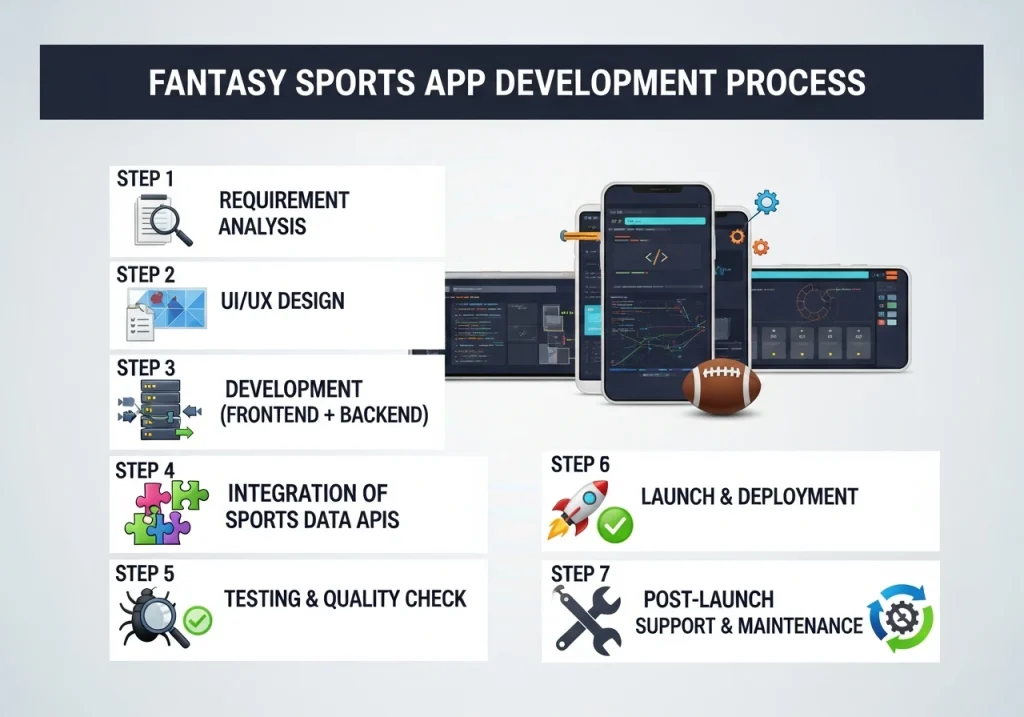
Fantasy Sports App Development Process
Here is a step-by-step process to build a fantasy sports app covering everything from planning to deployment and maintenance.
Step 1: Requirement Analysis
In this stage, the development team understands your business idea, target audience, and preferred fantasy format. You also decide important things like features, country regulations, and the type of sports to include. This step helps create a clear project plan, timeline, and cost estimation.
Step 2: UI/UX Design
Designers create wireframes to show how the app will look and how users will move through each screen. The goal is to keep the interface simple, attractive, and easy for all types of users. Once approved, the team designs high-quality UI screens with smooth navigation.
Step 3: Development (Frontend + Backend)
Developers start building the app’s structure, coding both the user side (frontend) and the admin dashboard (backend). They set up secure servers, databases, and payment systems to ensure everything runs smoothly. This phase also includes integrating APIs, wallets, contests, scoring systems, and gameplay logic.
Step 4: Integration of Sports Data APIs
Here, developers connect to sports data providers that supply live scores, player performance, and match schedules. These Fantasy Sports APIs ensure that fantasy points update in real time when matches are live. Proper API integration improves accuracy and enhances the user experience.
Step 5: Testing & Quality Check
Testers check every feature, button, and flow to make sure the app runs smoothly without bugs. Security testing ensures that payments, user data, and game results remain safe from misuse. Load testing checks if the app can handle thousands of users during peak match time.
Step 6: Launch & Deployment
Once everything is tested, the app is published on Google Play, the App Store, and web platforms. The team ensures the app follows all store guidelines and passes quality checks. A smooth deployment ensures users can download and use the app without any issues.
Step 7: Post-Launch Support & Maintenance
After launching, developers continuously monitor the app for performance and fix any issues that appear. You also receive regular updates to improve speed, features, and security. This ensures the app stays competitive and delivers a great experience throughout sports seasons.
Get a Personalized Quote for Your Fantasy Sports App
Let our experts provide you with a customized development plan and cost estimate based on your app’s features and scale.
On average, the cost of developing a fantasy sports app is around $15,000 to $100,000+, depending on the type of app, features, functions, complexities, and integrations. For a detailed breakdown of pricing and factors, check out Cost to develop a fantasy sports app guide.
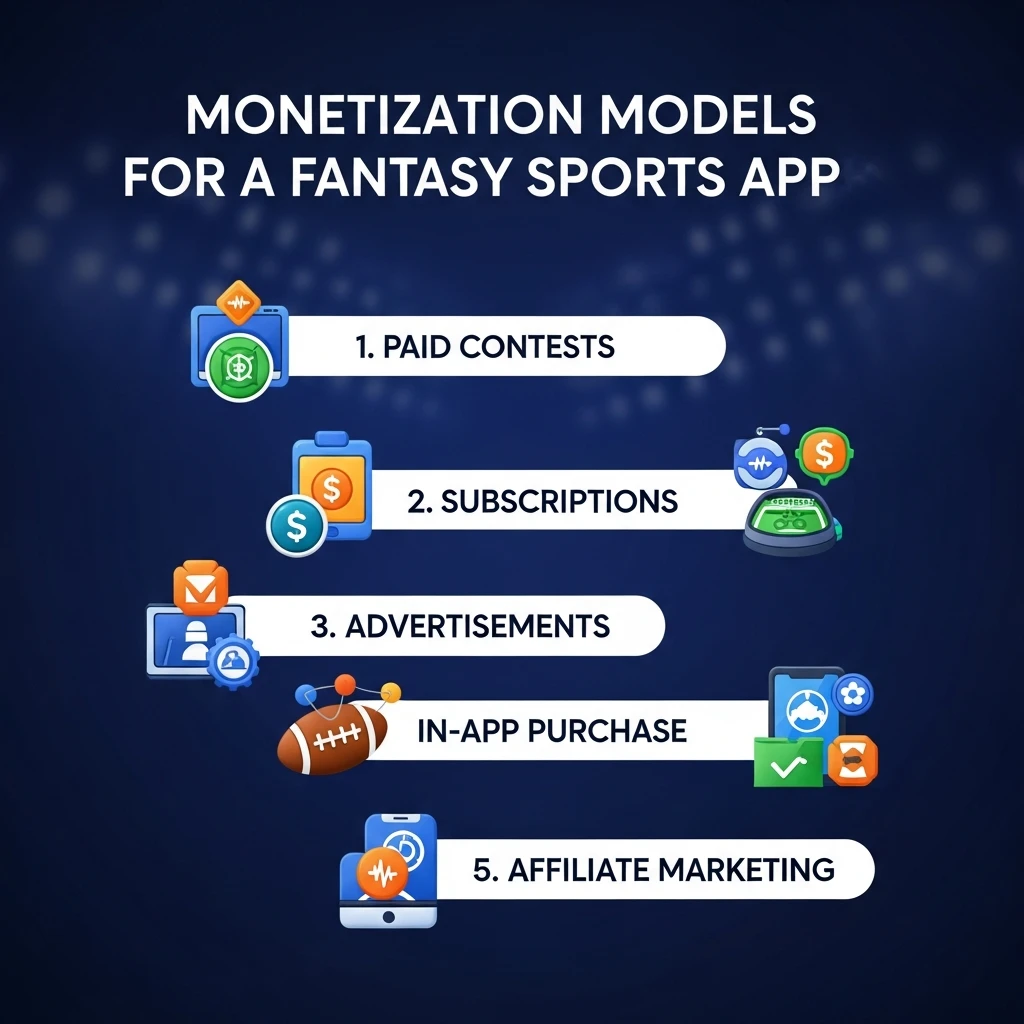
Monetization Models for a Fantasy Sports App
Paid Contests
Users pay a small entry fee to join contests and compete for cash rewards. This is the main revenue source because most players participate in paid matches during big leagues.
Subscriptions
Users can buy monthly or yearly plans to unlock premium tools like advanced stats or AI-based team suggestions. This creates a stable, recurring income for the platform.
Advertisements
Apps earn money by showing banner ads, video ads, and sponsored content inside the platform. Advertisers pay more during popular tournaments because user traffic is high.
In-App Purchases
Users can buy add-ons like extra tokens, lineup boosts, or premium contest entries to improve their gameplay. These small micro-purchases add up and generate consistent income.
Affiliate Marketing
The app promotes sports gear, accessories, or ticketing partners and earns a commission on each sale. It’s an easy, low-effort revenue stream that runs in the background.
Legal Requirements & Compliance
This is important for fantasy sports apps that involve rewards and real money. Here is a list of requirements that must be fulfilled in order to run a fantasy sports app trouble-free.
Understand local fantasy sports laws so that you are well aware of what types of activities are allowed and what are not.
Create transparent terms & conditions so that users are well aware of everything related to fantasy gaming, your platform, and legal rules.
Follow KYC & AML rules to verify user identity and prevent fraud or illegal activities on your platform. This keeps your app safe, compliant, and trusted by users.
Add responsible gaming guidelines so users understand how to play safely and avoid unhealthy gaming habits. This builds trust and shows that your platform supports fair and mindful gameplay.
Allow age verification to ensure only eligible users can join contests and participate in fantasy sports. This helps you follow legal rules and protect minors from real-money gameplay.
Ensure data protection & privacy to keep user information safe from misuse, hacking, or unauthorized access. This keeps your platform compliant with data laws.
Fantasy laws differ by country or state, so it is important to consult legal experts before launching your fantasy sports software.
Challenges in Developing Fantasy Sports Apps
Challenge: Understanding complex fantasy sports laws and compliance rules can be confusing for new operators.
Solution: Know your local fantasy sports laws so you clearly understand what activities are allowed and what are restricted.
Challenge: Users may feel unsure about game rules, payouts, or platform policies, which reduces trust.
Solution: Create clear and transparent Terms & Conditions so users understand everything about gameplay, rules, and legal guidelines.
Challenge: Fraud, multiple accounts, and illegal transactions can harm the platform and user trust.
Solution: Follow KYC & AML rules to verify users properly and prevent fraud, fake accounts, and suspicious financial activities.
Challenge: Some players may develop unhealthy gaming patterns or overspend in contests.
Solution: Add responsible gaming guidelines to encourage safe play and help users manage their gaming habits.
Challenge: Minors may try to register and participate in real-money contests, which is legally risky.
Solution: Allow age verification so only eligible users can access paid contests and meet legal age requirements.
Challenge: User data, payments, and personal details are at risk if security measures are weak.
Solution: Ensure data protection & privacy to keep all user information safe from misuse, hacking, or unauthorized access.
User Retention Techniques
Here are the techniques to keep the users active towards your fantasy sports platform:
Daily login rewards: Small prizes for opening the app daily.
Seasonal tournaments: Big contests during major leagues.
Push notifications: Quick match and contest reminders.
Weekly challenges: Fun tasks to keep users engaged.
Referral bonuses: Rewards for inviting friends.
Personalized player suggestions: Smart tips based on user habits.
In-app social communities: Chat groups for fans to interact.
Why Fantasy Sports Apps Fail
Understanding failure points helps you avoid them.
Poor scoring accuracy
Bad UI/UX
Limited contests
Weak security
Lack of continuous innovation
Server crashes under load
No marketing or user acquisition strategy
Successful apps update their features frequently and keep users engaged.
Create Your Fantasy Sports App At BR Softech
BR Softech is a leading fantasy sports app development agency with more than 13 years of experience in the fantasy sports industry. Our developers specialize in developing fantasy sports apps for smartphones running on Android and iOS.
We offer all types of fantasy sports solutions, including:
Cross-platform fantasy sports apps
Native fantasy sports apps
White label fantasy sports apps
Custom fantasy sports apps
Fantasy sports API integration
Odds and data feeds integration
App updates and maintenance services
If you want to build a fantasy sports app of any type and scale, just contact us, and we will handle all your requirements without compromising quality and performance, all while being the most cost-effective.
Ready to Launch Your Fantasy Sports App?
Contact our expert developers at BR Softech today and get a customized fantasy sports solution that drives engagement and revenue.
It is the process of building an online platform where users can create virtual teams, track live scores, and earn points based on the real match performance of real players. It’s just that users are rewarded on the basis of live performances on the ground.
How do you create a fantasy app?
Decide on your game model, design UI, build backend, integrate sports data APIs, set up scoring system, add payment methods and gateway, test the app, and launch it on app stores.
How much does it cost to build a fantasy sports app?
A basic app may cost $15,000 to $35,000. Advanced apps with AI, analytics, and more features can cost $70,000 to $100,000+.
What features should a fantasy sports app have?
Team creation, contests, live scoring, payments, leaderboards, notifications, and admin controls are some of the vital features that are needed in a fantasy sports app.
Can I build a daily fantasy sports app like FanDuel?
Yes, you can build a DFS model with player selection, paid contests, scoring, and real-time updates.
Do you need sports data APIs?
Yes, APIs provide match schedules, live scores, player stats, and other ground information to keep the users up to date on what’s happening in the match.
Are fantasy sports apps legal?
Legality depends on your country or state. If there are some restrictions, then your platform must follow them. Check local gaming laws before launching.
Can I earn money with a fantasy sports app?
Yes, you can earn money with a fantasy sports application monetization strategy, such as paid contests, ads, subscriptions, and partnerships.
How long does development take?
On average, a fantasy sports app can take between 2 to 10 months, depending on the app type, complexities involved, features list, and integrations.
Which tech stack is best?
Flutter/React Native for mobile, Node.js/Python for backend, PostgreSQL for database, and AWS for cloud hosting.
Nitin Garg is a seasoned tech entrepreneur and the visionary founder of BR Softech, a globally recognized leader in game development. With over 13 years of industry experience, he has been instrumental in transforming BR Softech into a powerhouse of innovation, offering cutting-edge solutions in Video Games, Blockchain Games, NFT Game Development, and card games like Poker, Rummy, and Teen Patti.
Nitin’s deep expertise in emerging technologies, combined with a sharp business acumen, has helped position BR Softech as a trusted name in the international gaming arena. Under his leadership, BR Softech has built a global clientele of 3,000+ satisfied customers and scaled a dedicated in-house team of 180+ skilled professionals.