In the era of complex titles, the dominance of hyper casual games with simple game mechanics and easy accessibility is at its peak. Its simplicity, easy accessibility, and addictive gameplay make it a good hyper casual game. But don’t have this misconception in your mind that it only has those basic graphics and gameplay.
As we enter 2026, the hyper-casual genre is evolving into smarter, more engaging experiences that blend intuitive design with strategic monetization. In this blog, you will discover what crucial elements make a hyper-casual game stand out from the crowd.
Hyper-casual games are categorized into mobile games, which include easy game mechanics, captivating game design, and provide an instant-play experience. These games are specifically designed to be lightweight, engaging, and addictive, and generally include single-finger controls like swiping, tapping, or timing-based actions.
Though in 2026, the definition of a hyper casual game is expanding. Developers are integrating elements of meta-progression, light social features, and reward-based to keep players excited about the game for a longer period of time. While the genre’s foundation remains rooted in simplicity, modern games now use data-driven design, player metrics, and monetization strategies to gain both engagement and profitability.
What are the Core Characteristics of Hyper Casual Games?
Instant Playability: Minimal loading, zero onboarding friction.
Minimalistic Design: Clean visuals that prioritize gameplay clarity over aesthetics.
Short Play Sessions: Perfect for on-the-go gaming, keeping retention high.
Replayability: Addictive loops that encourage “just one more try.”
Ad-Driven Monetization: Revenue mainly from interstitial and rewarded video ads.
What are the Core Mechanics of a Hyper-Casual Game?
The gameplay mechanics are the soul of any game; if the gameplay is easy, it automatically attracts users towards it. In 2026, hyper causal game mechanics continue to evolve, blending minimalist design with creative variations that maximize engagement, virality, and retention.
Tap-To-Jump
Games like Flappy Bird, Dune, and Swing Copters include these gameplay mechanics, where players frequently tap the screen to control vertical movement or jump timing while avoiding obstacles or maintaining flight.
Extremely simple to understand, one-tap control.
Encourages “one more try” behavior through instant restarts.
Perfect for short, repeatable play sessions.
Swipe-to-Control
Helix Jump and Knife Hit are the games that use swipe controls like right, left, or in circular motion to rotate, steer, or aim objects. The difficulty in the game increases progressively with level design. It uses natural touch gestures, making gameplay interesting. It also:
Delivers instant visual feedback through smooth physics and animations.
Works seamlessly across mobile devices and screen sizes.
Stack and Build Mechanics
In many games like Stack, Tower Run, and Perfect Tower, players balance and align objects to build towers or structures, testing precision and timing. Visually satisfying, players love achieving perfect stacks. It also naturally builds tension and excitement as the structure grows.
Drag-and-Drop / Aim-and-Release
Angry Birds is the best example of a drag-and-drop mechanism. You very well know here that players drag to set direction and power, then release to act like laughing, throwing, or flipping. It also
Adds tactile satisfaction through tension and release.
Combines skill and timing with physics-based unpredictability.
Great for creating satisfying “success moments” worth sharing.
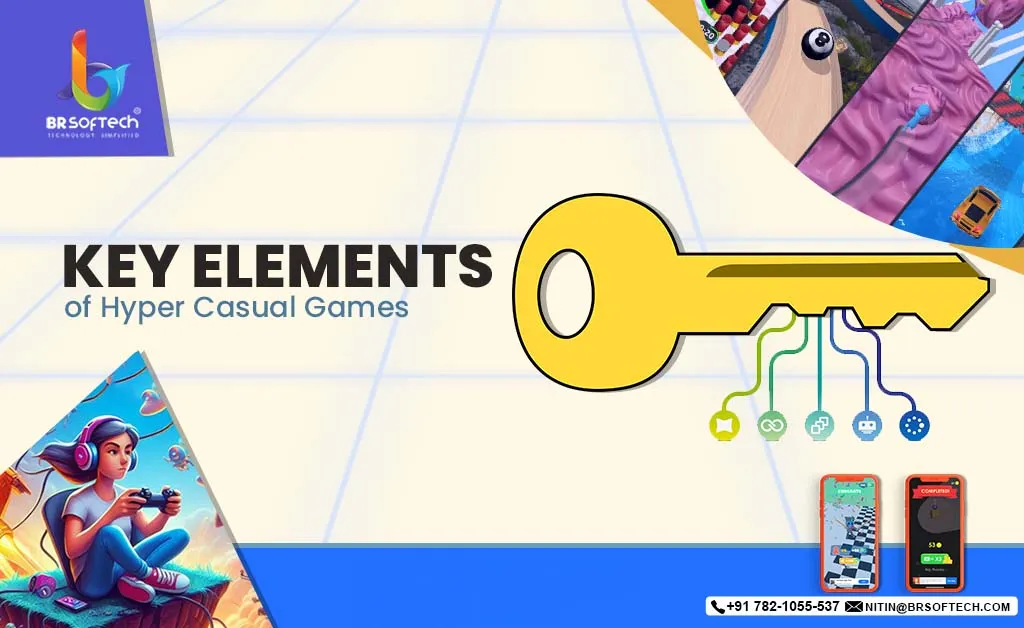
What are the Key Elements of Hyper-Casual Games?
To build a successful hyper casual title in 2026, both entrepreneurs and developers should know how to keep the balance between simplicity, engagement, retention, and monetization. These games are getting successful on the basis of a basic mechanism, but on a fine ecosystem of design, feedback, and strategy that makes the experience universally appealing.
Below are the hyper casual game mechanics examples that you should know.
Simple Core Gameplay
This is the backbone of the hyper-casual game, a single, easily understood action that defines the entire experience. The main aim of this game mechanic is to make the game playable within seconds of launch, with zero learning difficulty.
What you should do:
Focus on one central mechanic (e.g., tap, drag, or swipe)
Remove unnecessary UI clutter
Make sure the players understand the game level visually; no tutorial is needed
Minimal Visual Design
Hyper-casual games don’t believe in complexity; they add simple graphics that automatically attract users. In 2026, minimal designs are not boring; they are considered aesthetic clarity optimized for performance across all devices.
Here are the design guidelines for entrepreneurs:
Use bold colors and simple shapes for clear readability.
Avoid detailed textures that distract from mechanics.
Doesn’t want quick feedback, as per my experience, everyone does, and deserves it also. It is one of the best hyper casual game mechanics examples as it creates a sense of satisfaction among the players towards the game.
You can use techniques like:
Use relatable feedback, visual bursts, and sound cues for impact.
Reward effort with small progression goals like skins and achievements.
Try to include a smooth transition between failure and replay, like quick restarts boost retention.
Short Addictive Sessions
Short gaming sessions are the new trend in the 2026 gaming market. The quick gameplay loops in a game encourage the players to repeat attempts. The player should feel a sense of progress in less time, even if they fail.
Other Key Elements of Hyper Casual Games (2026)
The year 2026 is full of opportunities for players and entrepreneurs as well. However, in addition to the elements mentioned above, you should also focus on some extra elements that will help you grow your gaming business.
Category
Element
Purpose
Gameplay
Progressive Difficulty
Keeps players engaged longer.
UX / Design
Minimal UI & Fast Restart
Ensures instant play and smooth flow.
Visuals
Bold Colors & Simple Shapes
Improves clarity and appeal.
Rewards
Juicy Feedback & Unlockables
Adds satisfaction and progression.
Monetization
Rewarded Ads & Light IAP
Boosts revenue without harming UX.
Analytics
CPI & Retention Testing
Validates ideas before scaling.
Engagement
Leaderboards & Sharing
Drives competition and virality.
Performance
Lightweight Build
Faster downloads, broader reach.
Final Words
Hyper casual games are becoming the cornerstone of the gaming industry. With its emerging technology, new trends, creativity, and captivating designs, it always stays ahead in the competition. For entrepreneurs, it is the best time to invest in hyper casual games. You only need to find a reputable hyper casual game development company for your project.
Frequently Asked Questions (FAQs)
Q.1 Why should entrepreneurs invest in hyper-casual games in 2026?
Ans. In 2026, the hyper-casual gaming market continues to grow due to its low development cost, wide audience reach, and fast monetization cycles. These games offer quick ROI and scalability potential, making them ideal for entrepreneurs looking for high engagement with minimal investment.
Q.2 How long does it typically take to develop and launch a hyper-casual game?
Ans. A basic hyper-casual game takes 4–8 weeks from concept to launch. The rapid development cycle allows studios to test multiple prototypes quickly and scale only those with strong player performance metrics.
Q.3 What metrics should entrepreneurs track for a hyper-casual game’s success?
Ans. Entrepreneurs should focus on key performance indicators such as Cost Per Install (CPI), Day-1 and Day-7 retention, average session time, and average revenue per user (ARPU). These metrics help assess user acquisition costs, player engagement, and overall profitability. A low CPI and high retention rate generally indicate a scalable and sustainable game.
Q.4 What mistakes should I, as an entrepreneur, avoid when creating a hyper-casual game?
Ans. Common mistakes include overcomplicating gameplay, ignoring analytics, and showing too many ads too soon. Failing to test CPI or skipping user feedback can also lead to poor performance. Entrepreneurs should prioritize simplicity, quick iteration, and data-driven decisions to ensure their game aligns with user expectations and market trends.
Q.5 What are all the trends I can expect in 2026 with hyper casual games?
Ans. Key trends include hybrid monetization, light progression systems, social features like leaderboards, and AI-driven difficulty adjustments. Developers are also focusing on sustainability and longer player lifecycles by introducing meta-progression. These advancements keep players engaged beyond the first few days while maintaining the genre’s hallmark simplicity.
Q.6 What are the best markets and platforms for hyper casual games for a profitable business?
Ans. The best platforms are Android and iOS, with Android offering a wider reach and lower acquisition costs, while iOS provides higher user value. The fastest-growing markets in 2026 include India, Southeast Asia, and the Middle East. These regions offer high download potential and cost-effective advertising, making them ideal for scaling hyper-casual games globally.
Nitin Garg is a seasoned tech entrepreneur and the visionary founder of BR Softech, a globally recognized leader in game development. With over 13 years of industry experience, he has been instrumental in transforming BR Softech into a powerhouse of innovation, offering cutting-edge solutions in Video Games, Blockchain Games, NFT Game Development, and card games like Poker, Rummy, and Teen Patti.
Nitin’s deep expertise in emerging technologies, combined with a sharp business acumen, has helped position BR Softech as a trusted name in the international gaming arena. Under his leadership, BR Softech has built a global clientele of 3,000+ satisfied customers and scaled a dedicated in-house team of 180+ skilled professionals.