Sports betting apps have truly changed the way people used to bet. Today, users can bet on their favorite sports anytime and from anywhere. This is all only possible due to fast, secure, and easy-to-use apps. Because of this rapid growth, there are many businesses that now want to build their own sports betting app. Reason? Because it is a profitable market.
If you are someone who wants to launch a sports betting platform, then you are at the right place. Here in this article, you will find the features, technology, development process, cost, and legal rules that are involved in sports betting app development. Let’s begin!
Sports betting app development is the process of creating an online platform where users can place bets on different sports and events through a mobile app or website. Users can see live scores, check odds, place bets, add money, and withdraw winnings. Conclusively, they enjoy a smooth betting experience from any location.
A complete sports betting app includes:
A user app
An admin panel
A backend system
Secure payment gateways
Betting odds & data feeds
Live match updates
The primary aim of creating a betting app is to offer a safe, fast, and easy-to-use environment that follows all legal rules and protects user data. With the right features and technology, businesses can attract more users to generate a steady revenue.
How Do Sports Betting Apps Work?
Sports betting apps work in a simple flow. They connect users with the real-time sports data, odds, and secure payment systems so they can place bets instantly. Here is the working process:
User Registration & KYC
The user signs up using email, phone, or social login. Basic KYC verification is done to confirm age and identity.
Fund Deposit
Users add money to their wallet using credit/debit cards, net banking, crypto, or other payment methods.
Browse Sports & Events
Users see a list of sports like cricket, football, basketball, and more. They can check ongoing matches, upcoming matches, and betting markets.
Real-Time Odds Display
The app shows dynamic betting odds that change based on live match conditions. Odds are sourced through third-party sports betting APIs or data providers.
Place a Bet
Users select a match, choose a betting market, and enter the amount they want to stake. The app confirms the bet instantly.
Live Match Updates
Users get access to live score updates, ball-by-ball stats, and changing odds during in-play betting.
Result Calculation
Once the match ends, the system automatically calculates winnings using preset algorithms and verified data feeds.
Withdraw Winnings
Users can withdraw money securely to their bank account or preferred payment method.
Admin Management
The admin dashboard tracks the following metrics:
Users
Payments
Reports
Betting markets
Risk management
Odds management
Bonuses & promotions
This smooth workflow creates a seamless and secure betting experience for users and allows the operators to manage the platform efficiently.
Types of Sports Betting Apps
There are different types of sports betting apps depending on the betting style, user needs, and business goals. Here are the main types of betting apps that businesses usually develop:
Sportsbook Apps
These are normal betting apps where users can bet on sports like cricket, football, tennis, basketball, and more. Many sportsbook apps allow betting before events, and many allow betting during events.
Examples: Bet365, DraftKings.
In-Play / Live Betting Apps
These apps allow users to place bets while the match is happening. The odds update in real time on the basis of score changes, wickets, goals, and live performance.
Exchange Betting Apps
In these platforms, users bet against each other instead of betting against the bookmaker.
Example: Betfair Exchange.
Fantasy Sports Apps
Here, users create virtual teams and earn points on the basis of the real-time performance of the players.
Examples: FanDuel, Yahoo Fantasy.
eSports Betting Apps
These apps focus on eSports tournaments like DOTA 2, CS: GO, Valorant, and PUBG Mobile.
Examples: Betway, BetOnline.
Hybrid Betting (Casino+Sports) Apps
There are some platforms that offer both casino games and online betting games in a single app.
Examples: 1xBet, Betway.
White-Label Betting Apps
White label sports betting apps are ready-made and can be quickly customized with branding, features, and payments. They are fast to launch and are very affordable.
Blockchain-Based Betting Apps
These apps use blockchain and smart contracts to offer maximum transparency, provably fair, and decentralized betting. To better understand market leaders, you can explore the top sports betting applications used globally.
What are the Key Features of a Sports Betting App
A successful sports betting app needs both basic features for users to bet easily and advanced features in order to stand out in the competitive market:
User Features
Feature
Description
Registration & KYC
Choose from Moneyline, Parlay, Totals, Prop bets, and Futures.
Wallet & Payments
Add money via cards, UPI, net banking, crypto, e-wallets.
Live Betting
Place bets in real-time as the match progresses.
Betting Markets
Choose from Moneyline, Parlay, Totals, Prop bets, Futures.
Odds Display
Dynamic, real-time odds updates.
Notifications
Alerts for results, match updates, promotions.
Multi-Language
Support for global users.
Social Features
Chat, friend invites, group betting.
Admin Features
Feature
Description
User Management
Track revenue, user activity, and bet trends.
Payment Management
Approve deposits/withdrawals, fraud detection.
Risk & Odds Management
Set odds, limits, and control payouts.
Analytics & Reports
Manage referral programs, cashback, and loyalty rewards.
Create mobile apps (iOS & Android) and websites (as per requirement)
Make loading quick, efficient, and smooth
Connect the frontend with the backend and APIs securely
6. Payment & Security Integration
Integrate secure payment gateways for deposits and withdrawals
Add tools like fraud detection, KYC verification, and encryption to keep user and financial data safe
7. Testing & Quality Assurance
Test the performance, security, and usability of the app
Perform testing on functional, performance, and stress parameters
Find and fix bugs and optimize the load times of features
8. Deployment & Launch
Deploy apps on Google Play Store, Apple App Store, and web
Set up server hosting and backend monitoring
Launch marketing campaigns and promotions to expand the reach of your sports betting platform
9. Post-Launch Support & Updates
Add live matches, new sports, and betting markets over time
Monitor performance, user behavior, and feedback to make improvements
Roll out regular updates with new features and bug fixes
Sports Betting App Development Cost in 2026
The average cost of developing a sports betting app ranges between $10,000 to $100,000+, depending on the features, complexity, platform, and location of the development team.
Here is a table showing the cost breakdown on the basis of app type:
App Type
Features
Cost (USD)
Basic / MVP
User registration, wallet, simple betting, and admin panel
$10,000–$20,000
Mid-Level
Live betting, multiple bet types, push notifications, analytics
$20,000–$50,000
Advanced
AI predictions, real-time odds, blockchain, live streaming
$50,000 – $100,000+
White-Label
Pre-built solution, branding customization
$15,000–$50,000
Here are the factors affecting the overall cost:
Team Location & Rates:
US/Canada ($100–150/hr), Eastern Europe ($40–80/hr), Asia ($15–30/hr)
Features & Complexity:
Advanced features like live streaming, AI, and blockchain increase cost.
Third-Party Integrations:
Payment gateways, live odds APIs, and KYC/AML systems increase the overall cost.
Security & Compliance:
SSL, 2FA, encryption, and licensing fees are non-negotiable and add up in the budget.
UI/UX Design:
Custom animations, live bet interface, and responsive design.
Maintenance & Hosting:
Around 15–25% of the initial cost yearly. This is also unavoidable.
Sports betting apps can generate a great amount of revenue, and that too in multiple ways. It is just that you have to choose the right model to ensure that your app remains profitable and sustainable. Here are the monetization models you can implement:
1. Commission-Based Model
The app earns a percentage in the form of commission for every bet that is placed. It is common in exchange betting apps.
Example: Betfair takes a commission on winning bets.
2. Fixed Odds / Margin Model
In this model, the app sets the odds for each bet and keeps the margin. It is mostly found in traditional sportsbook apps.
Example: Bet365 uses this for football, cricket, and other sports.
3. Subscription Model
Users pay a monthly or yearly subscription fee to get premium features, analytics, or exclusive betting tips. This model is quite popular in advanced prediction or AI-assisted betting apps.
Example: Purchasing an ad-free version of the app.
4. Advertising & Sponsorship
Putting ads and banners is the most common way to monetize the app. Also, partnerships with popular brands can help to generate extra income. This works best for apps with a large user base.
Example: Showing image ads or video ads.
5. In-App Purchases & Gamification
Users purchase coins, tokens, or boosters for enhanced experience, leaderboards, or virtual leagues. This not only engages pro users but also creates additional revenue streams.
6. Affiliate & Referral Programs
It encourages the existing users to refer their friends and earn a bonus for every new user who successfully joins the app or places bets. It helps to grow your user base while also generating indirect revenue.
Example: Referring a friend, and both parties get a bonus.
Legal & Licensing Requirements for Sports Betting Apps
It involves strict legal compliance for developing and operating a sports betting app. The rules differ from country to country, region to region, and even state to state. Failing to follow them can lead to fines, bans, or legal issues.
1. Obtain a Betting License
The first step is to get the required licenses to legally operate a betting app. The licenses are issued by government authorities or regulatory bodies.
Common jurisdictions include:
Regulating Body
Country
Operations
UK Gambling Commission (UKGC)
United Kingdom
Worldwide
Malta Gaming Authority (MGA)
Malta
Worldwide
Curacao eGaming
Curacao
Worldwide
US (Individual State Regulation)
US
Only in the States (e.g., New Jersey, Pennsylvania)
2. Age Verification & KYC
You need to implement an age verification & KYC system so as to disallow users who are below 18 years of age or 21 years in some regions. KYC verification ensures identification and prevents fraud
3. Anti-Money Laundering (AML) Compliance
AML detects suspicious transactions. You can prevent illegal money flow by following international AML regulations.
4. Data Protection & Privacy
You must protect user data with the help of GDPR, CCPA, or other regional privacy laws. You must also encrypt sensitive information such as payment details, personal data, and betting history to maintain platform integrity.
5. Geo-Restrictions
Betting laws are different in every place. It is even different in states (e.g., US). It is extremely important to implement geo-fencing techniques in your app to restrict access in regions where betting is illegal.
6. Payment & Tax Compliance
All the payments must be processed legally and securely. Your platform must follow regional tax rules for winnings, deposits, and revenue reporting.
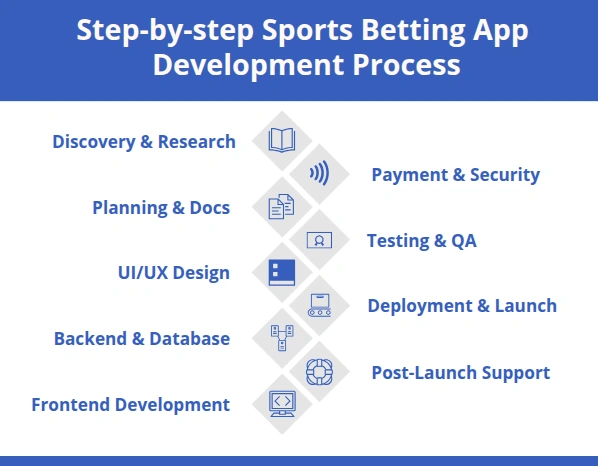
Timeline & Process for Sports Betting App Development
Developing a sports betting app involves multiple stages. Each phase ensures the app is secure, scalable, and user-friendly. Below is a typical timeline:
Phase
Tasks
Duration
Discovery & Research
Market analysis, competitor study, and requirement gathering
1–2 weeks
Planning & Documentation
Wireframes, feature list, tech stack decision
1–2 weeks
UI/UX Design
App design, user interface, prototypes
2–3 weeks
Backend Development
Server setup, database, API integrations
4–6 weeks
Frontend Development
Mobile app (iOS/Android), web dashboard
3–5 weeks
Payment & Security Integration
Payment gateways, SSL, 2FA, fraud prevention
1–2 weeks
Testing & QA
Functional, performance, and security testing
2–3 weeks
Deployment & Launch
App store submission, server deployment
1 week
Post-Launch Support
Bug fixes, updates, and feature upgrades
Ongoing
Key Notes:
Total Development Time: 3 to 6 months (depending on features and complexity)
MVP Launch: Basic app can be launched in a maximum of 2 to 3 months
Advanced Features: AI predictions, live streaming, and blockchain may extend development by 1 to 2 months
Ongoing Updates: Regular updates are timely to improve user engagement and retention
How to Choose the Right Sports Betting App Development Partner
It is a critical decision to choose a sports betting app development partner. This is so because everything depends on the partner, as it is the one who will build your sports betting app and make it successful. Here are what you need to consider when picking the right one:
1. Experience in Sports Betting Apps
Check if the company has built similar apps before. During consultation, ask for their portfolio examples and check client reviews to gather insights about their experience. The experience ensures that they develop reliably, and there will be fewer chances of mistakes.
2. Technical Expertise
Technical expertise is equally important. Today, emerging techs like AI, Blockchain, and Web3 are becoming mainstream. Ensure that the company is skilled in the latest technologies, real-time APIs, and multi-platform development. Strong backend and frontend skills are necessary for smooth performance.
3. Compliance Knowledge
A good company is well informed about the regional and international gaming laws, licensing, KYC/AML requirements, and data privacy regulations. This reduces the legal risks during and after the launch.
4. Customization & Flexibility
Choose a company that offers custom sports betting app development or flexible white-label solutions. Customization ensures that you develop an app that stands out in the crowded market.
5. Transparent Pricing & Timelines
Don’t hesitate to ask for a detailed cost quotation and project timelines. Thoroughly check the documentation and clearly confirm with them if there are any hidden fees or unrealistic delivery promises.
6. Post-Launch Support
After launch, support is helpful to keep your app fresh and problem-free. Check if they provide maintenance, updates, and bug fixes.
Hire Expert Sports Betting Developers
Work with certified developers to build a secure, scalable, and profitable betting app.
BR Softech is a trusted sports betting app development company with 13+ years of experience in the sports betting niche. We have helped numerous startups, businesses, and entrepreneurs across the globe to launch secure, feature-rich, and scalable betting platforms.
If you are interested in developing your own sports betting app, you are in the best place. Contact us to create the best betting app for your business.
The BR Softech Advantage: Why Businesses Trust Us
13+ years of industry experience
Successfully completed 100+ projects globally in the same domain
Deep technical expertise in AI, ML, Blockchain, React Native, Flutter, Node.js
24/7 on-demand support over phone/email/live
Cost-effective sports betting app solutions
Transparent, flexible, and competitive pricing
Industry-level security implementation
Frequently Asked Questions(FAQs)
What is the cost to develop a sports betting app?
The average cost of developing a sports betting app starts from $10,000 for a betting app with basic features, and can go over $100,000 for a full-featured, custom-made sports betting app with AI, blockchain integration, etc. For a ready-made white label solution, the cost can be between $15,000 to $50,000.
How do I make my own sports betting app?
To make your own sports betting app, you need to research the market, define your target audience, and choose the type of app. Design the app, develop frontend and backend, and integrate live betting and APIs. Follow legal laws and then launch the app.
Are sports betting apps profitable?
Yes, sports betting apps can be highly profitable. Revenue comes through several channels, like commissions on bets, profit margins built into the odds, paid subscriptions, in-app purchases, ads, and user referral bonuses. Apps with live betting, predictive analytics, and gamification tend to retain users longer and generate more revenue. Profitability also depends on market compliance, quality of the app, and marketing strategy to reach your audience effectively.
Is it legal to create a betting app?
Creating a betting app is legal only if you follow the laws of the country or state where you operate. You must obtain a betting license and follow data protection regulations like GDPR or local privacy laws. Some regions have strict restrictions, so it is important to include geo-fencing technology to prevent access in illegal areas. Compliance ensures your app operates safely and avoids fines, bans, or legal problems.
How does a sports betting app work?
A sports betting app works by allowing users to place bets on any sport, like cricket, soccer, etc, and payout the winning amount to the user through different payment modes.
Nitin Garg is a seasoned tech entrepreneur and the visionary founder of BR Softech, a globally recognized leader in game development. With over 13 years of industry experience, he has been instrumental in transforming BR Softech into a powerhouse of innovation, offering cutting-edge solutions in Video Games, Blockchain Games, NFT Game Development, and card games like Poker, Rummy, and Teen Patti.
Nitin’s deep expertise in emerging technologies, combined with a sharp business acumen, has helped position BR Softech as a trusted name in the international gaming arena. Under his leadership, BR Softech has built a global clientele of 3,000+ satisfied customers and scaled a dedicated in-house team of 180+ skilled professionals.